If you're sourcing custom flags for your business — whether for a product launch, a chain of retail locations, or a client's promotional campaign — one of the first questions you'll run into is how many you actually need to order. The custom flag MOQ (minimum order quantity) varies more wildly across suppliers than most buyers realize, from literally one piece to 125 or more. And the number itself is only half the story. The real question is where the per-unit price drops enough to make sense for your margins. This guide breaks down how MOQ structures work across different supplier types, flag formats, and sourcing channels — so you can figure out which approach fits your order size and budget, rather than just picking the first supplier who says "no minimum."
What MOQ Actually Means in the Custom Flag Market
[aiwriter engine="anthropic/claude-sonnet-4.6" id="225" name="自动写内容段落要求"]MOQ in custom flags isn't a single industry standard — it's a reflection of how a supplier has structured their production economics. A company advertising "no minimum order" hasn't eliminated setup costs. They've buried those costs into a higher per-unit price. A factory requiring 100 pieces hasn't arbitrarily chosen that number. It's roughly the threshold where the press setup time, ink mixing, and cutting templates get amortized enough to offer a price that actually makes sense for wholesale.
The spread is wider than most B2B buyers expect. At one end, you've got domestic print-on-demand providers fulfilling single custom flags at $30-50 each. At the other end, promotional mini flag specialists won't even start a run for fewer than 125 pieces. Most buyers land somewhere in between, and the mistake I see most often is fixating on the MOQ number itself rather than asking: at what quantity does my per-unit cost hit a number I can actually work with?
A supplier with no MOQ charging $35 per flag is technically more "accessible" than one requiring 50 pieces at $12 each. But if you need 75 flags for a trade show, the math isn't even close. The MOQ itself is just a gatekeeper — the pricing curve behind it is what determines whether you're getting a deal or paying a convenience premium.

No-MOQ, Low-MOQ, and High-MOQ Structures: Matching One to Your Situation
[aiwriter engine="anthropic/claude-sonnet-4.6" id="225" name="自动写内容段落要求"]Rather than listing every supplier and their policies side by side (which gets outdated fast), the more useful framework is understanding what each MOQ tier is designed for — and where each one breaks down.
No-MOQ suppliers are built for businesses testing a new design, ordering a one-off sample for client approval, or buying small quantities where speed matters more than cost. Companies like BestFlag, Anley Flags, and Custom Flag Company all operate in this space, typically offering automatic price breaks once you cross 3, 10, 25, or 100 units. The pricing at the single-unit level often runs 3-5x what you'd pay at volume. That's fine for a proof of concept. It's a terrible model for recurring orders.
Low-MOQ suppliers (minimum 2-10 units) occupy a middle ground that works surprisingly well for small agencies and event planners. BannerBuzz, for example, starts at 2 units and offers meaningful per-unit drops at 10+ and 100+ quantities. Band Shoppe requires only 3 units for their 36×54-inch flags. If your typical order is 10-50 flags with dye sublimation and screen printing services for flags, these suppliers are often the sweet spot — you get decent pricing without committing to inventory you don't need yet.
Then there are high-MOQ suppliers like Flagman and Flags USA, requiring 50-125 units minimum. These are almost exclusively relevant for small-format promotional items — 4×6-inch hand-held mini flags, the kind you see at political rallies or handed out at car dealerships. The MOQ is high because the per-unit production value is so low that running a press for 20 pieces doesn't cover setup time. If you're a custom promotional flag manufacturer buyer working at this scale, high-MOQ suppliers will give you the best unit economics, but you need to be confident in the design and quantity before committing.
Where the Real Per-Unit Savings Happen
[aiwriter engine="anthropic/claude-sonnet-4.6" id="225" name="自动写内容段落要求"]The pricing curve for custom flags isn't linear — and the steepest drop doesn't happen where most people assume. To illustrate: NorthStar Flags quotes 3×5-foot custom flags at roughly $18.97 per unit for 100 pieces, $15.24 at 250 units, $11.38 at 1,000, and $9.13 at 2,500. The biggest percentage drop per additional unit is between 100 and 250 — that's where you're getting roughly 20% off per unit by slightly more than doubling your order.
For most small-to-midsize businesses, the 50-250 unit range is where ordering strategy matters most. Below 50, you're almost certainly paying a premium no matter who you source from. Above 250, the per-unit savings still accumulate but at a flatter rate — the difference between 1,000 and 2,500 units is meaningful in absolute dollars but much less dramatic per piece.
One tactic that works well for businesses with ongoing flag needs: blanket orders with scheduled releases. You commit to 100 or 200 units to lock in the volume price, but take delivery in smaller batches — say, 25 flags per month. Not every supplier offers this, but it's common enough in the flag industry that it's worth asking. This approach is particularly useful for custom corporate flag manufacturer orders where a company needs flags across multiple locations but doesn't want to store 200 flags in a warehouse.
The non-obvious trap here: don't assume that the biggest order always means the best value. If you're ordering 300 units of a design you haven't tested in the field, and 40% of them end up in a closet because the colors looked different outdoors than on screen, you didn't save money. You overspent. For first-time designs, ordering at the 50-100 level — even at a slightly higher per-unit cost — is usually the smarter play.
How Flag Type Changes the MOQ Conversation
[aiwriter engine="anthropic/claude-sonnet-4.6" id="225" name="自动写内容段落要求"]Not all flags are equal when it comes to minimum order requirements, and the reason comes down to production complexity rather than fabric cost.
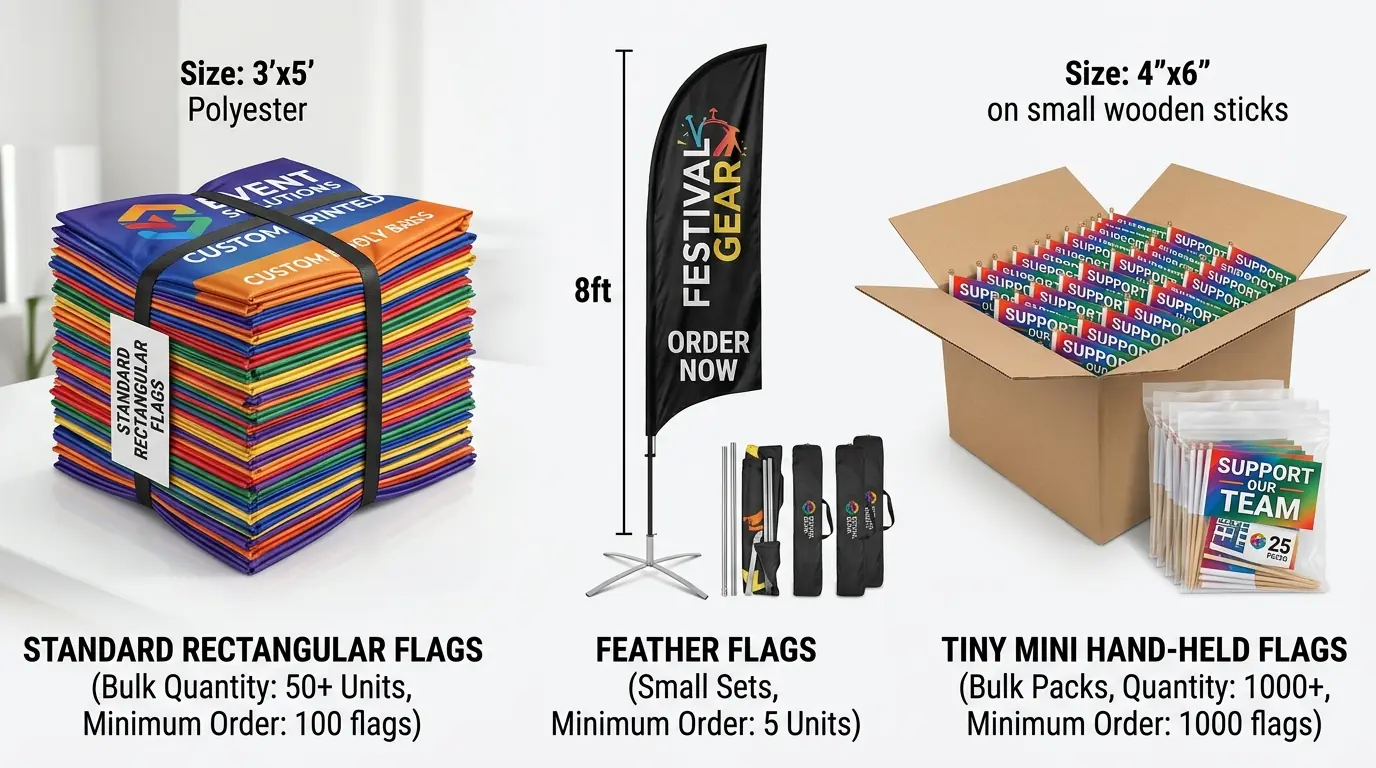
Standard rectangular flags — your typical 3×5-foot format — have the most flexible MOQs across the board. The cutting is simple, the hardware is universal, and every flag printer in the world has the setup dialed in. This is where you'll find no-MOQ options, low-MOQ options, and the deepest volume discounts. If you're working with a leading custom flag supplier, a standard rectangle order is the easiest format to negotiate on.
Specialty shapes are a different situation. Custom feather flag manufacturer products and custom teardrop flag manufacturer items typically carry a minimum of 3-10 units because each shape requires specific cutting dies, pole hardware, and sometimes unique base systems. The flag itself might print on the same equipment, but the post-production finishing — hemming curved edges, attaching pole sleeves for non-standard shapes — adds per-run setup that suppliers won't absorb for a single piece. Some will make a single feather flag, but they'll charge you a setup fee that effectively doubles or triples the unit cost.
Mini hand-held flags sit at the opposite extreme. At 4×6 inches, the per-unit value is so low (sometimes under $0.50 at volume) that the fixed costs of a production run — artwork prep, ink setup, cutting — are disproportionate to what each flag is worth. That's why suppliers like Flagman and Flags USA set their MOQ at 125 pieces. Below that quantity, they'd actually lose money. If you need small promotional flags and your order is under 100 units, you're almost certainly better off with a domestic digital printer charging more per piece than trying to find a factory willing to run a short batch.
Custom Flag MOQ: China Factory Direct vs. Domestic Suppliers
[aiwriter engine="anthropic/claude-sonnet-4.6" id="225" name="自动写内容段落要求"]This is where a lot of buyers overthink the decision — or worse, default to one channel without running the numbers for their specific order size.
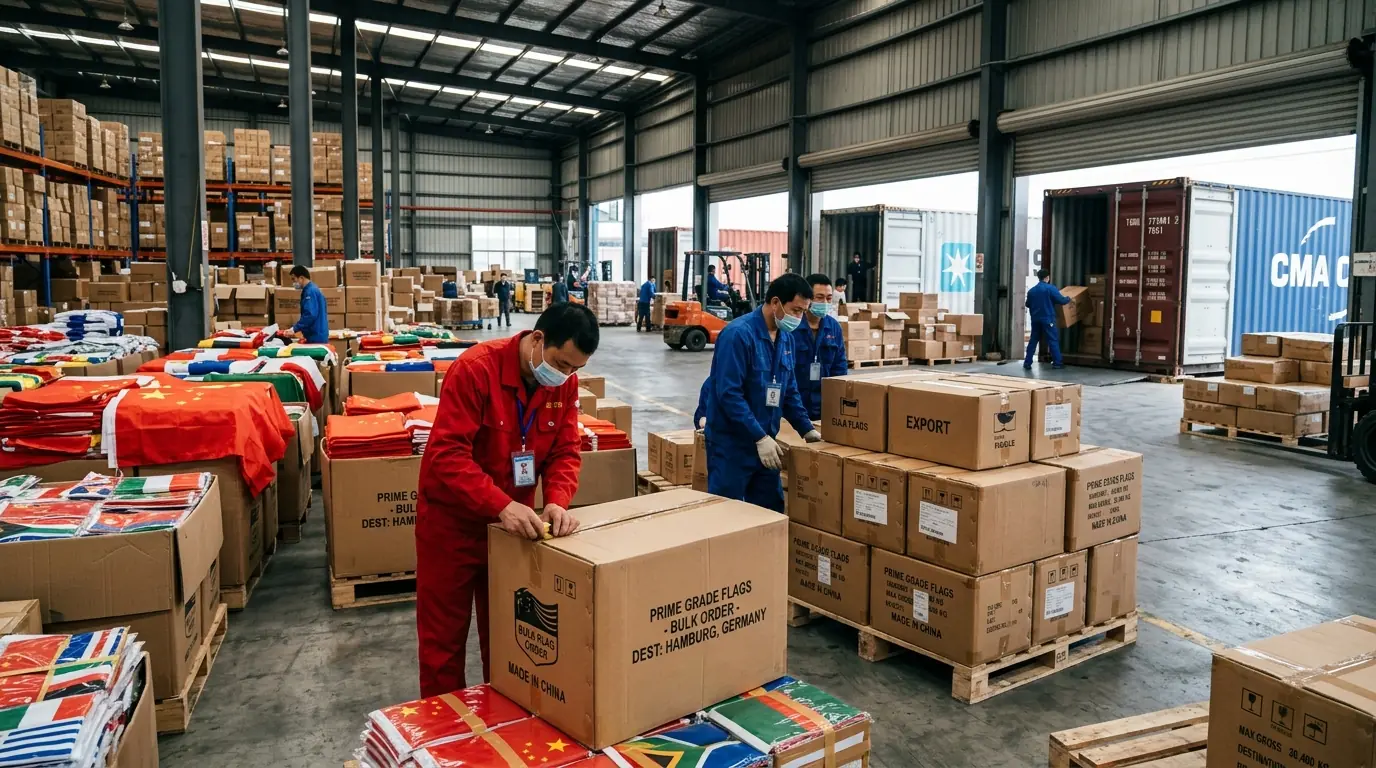
Chinese factories on Alibaba list MOQs ranging from 10 to 300+ pieces depending on the supplier. The price variation is enormous: you'll see listings showing 300-piece orders at $0.06-0.16 per flag (mini promotional flags), 50-piece orders at $8-11 per flag (standard printed flags), and 10-piece "samples" at near-retail pricing. The catch with factory-direct pricing at the low end is that it often excludes shipping, doesn't include the pole hardware, or represents a base-configuration quote that climbs once you specify materials and printing methods.
US domestic suppliers, by contrast, offer convenience and speed — most accept orders of 1-3 units for standard sizes. But you're paying 3-5x the per-unit cost compared to factory direct at volume. A 3×5-foot dye-sub flag that costs $9 from a Chinese factory at 500 units might cost $35-45 from a domestic no-MOQ printer.
The break-even point sits around 200 units in most cases. Above that quantity, China factory direct almost always wins on total cost even after international shipping (which typically adds $0.50-2.00 per flag when shipping by sea in bulk). Below 50 units, domestic suppliers usually win because the shipping cost, communication overhead, and lead time of international sourcing erode any per-unit savings. The gray zone — 50 to 200 units — depends heavily on your timeline and how much back-and-forth you're willing to handle.
If you're thinking about going the factory-direct route, it helps to understand the OEM flag ordering process from design to delivery before committing. The production timeline alone (20-35 days versus 7-15 for domestic) can be a dealbreaker if you're ordering for a specific event date. And I'd challenge anyone who assumes overseas sourcing is automatically cheaper to factor in the cost of a production error on a 300-unit order when you can't walk into the factory to inspect the run. A wrong Pantone match on 300 flags from a factory 8,000 miles away is a very expensive lesson.
Planning Your MOQ Strategy Across Multiple Orders
[aiwriter engine="anthropic/claude-sonnet-4.6" id="225" name="自动写内容段落要求"]Single-order thinking is the most common reason businesses overpay for custom flags. If you're a marketing agency placing separate orders for three different clients — 30 flags here, 20 there, 45 for another — you're paying small-order pricing three times. Consolidating those into a single production run of 95 units (even if they're different designs) can often cross a price-break threshold, especially with suppliers who tier pricing based on total order value rather than per-design quantity.
For businesses with predictable flag needs — think franchise groups replacing outdoor flags seasonally, or national flag manufacturer for government and institutions contracts — annual purchase agreements are worth negotiating. You estimate your full-year volume, commit to a total quantity, and lock in pricing that reflects the aggregate rather than each individual shipment. Not every supplier will do this, but it's standard practice with established manufacturers who want recurring business.
The thing that can undo all of this planning: rush orders. Standard domestic lead times run 7-15 business days. International orders typically need 20-35 days including shipping. If you wait until two weeks before an event to place an international order, you'll pay rush production fees and expedited air freight that can easily add 40-60% to your total cost — which wipes out whatever volume discount you negotiated. The cheapest flag order is the one placed early enough to ship by sea.
One more consideration that most guides skip: if you're ordering flags alongside display hardware — wholesale flagpole supplier with bulk pricing options or flag display system manufacturer packages — bundling flags and hardware in a single order from one supplier almost always gets you better total pricing than sourcing them separately. The supplier has a higher total order value to work with, and the logistics are simpler for everyone.
Conclusion: How to Decide on Your Custom Flag MOQ Approach
[aiwriter engine="anthropic/claude-sonnet-4.6" id="225" name="自动写内容段落要求"]The right custom flag MOQ strategy depends less on finding the lowest minimum and more on matching your order profile to the right supplier structure. Here's how to think about it based on where you are right now:
If you're testing a new design or ordering fewer than 25 flags: go with a domestic no-MOQ or low-MOQ supplier. Yes, you'll pay more per unit. That's the cost of flexibility, and it's worth it when you're not yet sure the design works.
If your order is 50-250 units and you have 3+ weeks of lead time: this is the range where shopping between domestic low-MOQ suppliers and Chinese factories starts to pay off. Get quotes from both and compare total landed cost — not just unit price.
If you're ordering 250+ units or placing multiple orders per year: factory-direct sourcing through an established manufacturer will almost certainly give you the best economics. Negotiate an annual agreement, use blanket orders with staged delivery, and plan far enough ahead to avoid rush fees.
Your next step: figure out your realistic annual flag volume across all uses — events, client orders, replacements, new locations. That single number determines which MOQ tier you should be targeting. Once you have it, request a free custom flag quote with your full quantity and timeline, and you'll get pricing that actually reflects your buying power rather than single-order rates.