If you're sourcing flags for outdoor advertising, events, or storefront promotion, the feather flag vs teardrop flag comparison is probably where your decision starts — and then blade flags enter the picture and make things more complicated. All three look similar in catalog photos, but they behave very differently in wind, carry different amounts of design space, and suit different business situations. The wrong choice doesn't just look bad — it wastes money on flags that wrap around poles, display unreadable graphics, or get replaced twice as fast as they should. This guide breaks down the real differences based on how these flags actually perform after installation, not just how they look in product renders. By the end, you should know exactly which type matches your use case without second-guessing.
Understanding The Three Flag Types: What Actually Differs
[aiwriter engine="anthropic/claude-sonnet-4.6" id="225" name="自动写内容段落要求"]The shape difference between these three flags isn't cosmetic — it determines how the flag attaches to the pole, which controls everything else: wind behavior, readable print area, and how often you'll be replacing fabric.
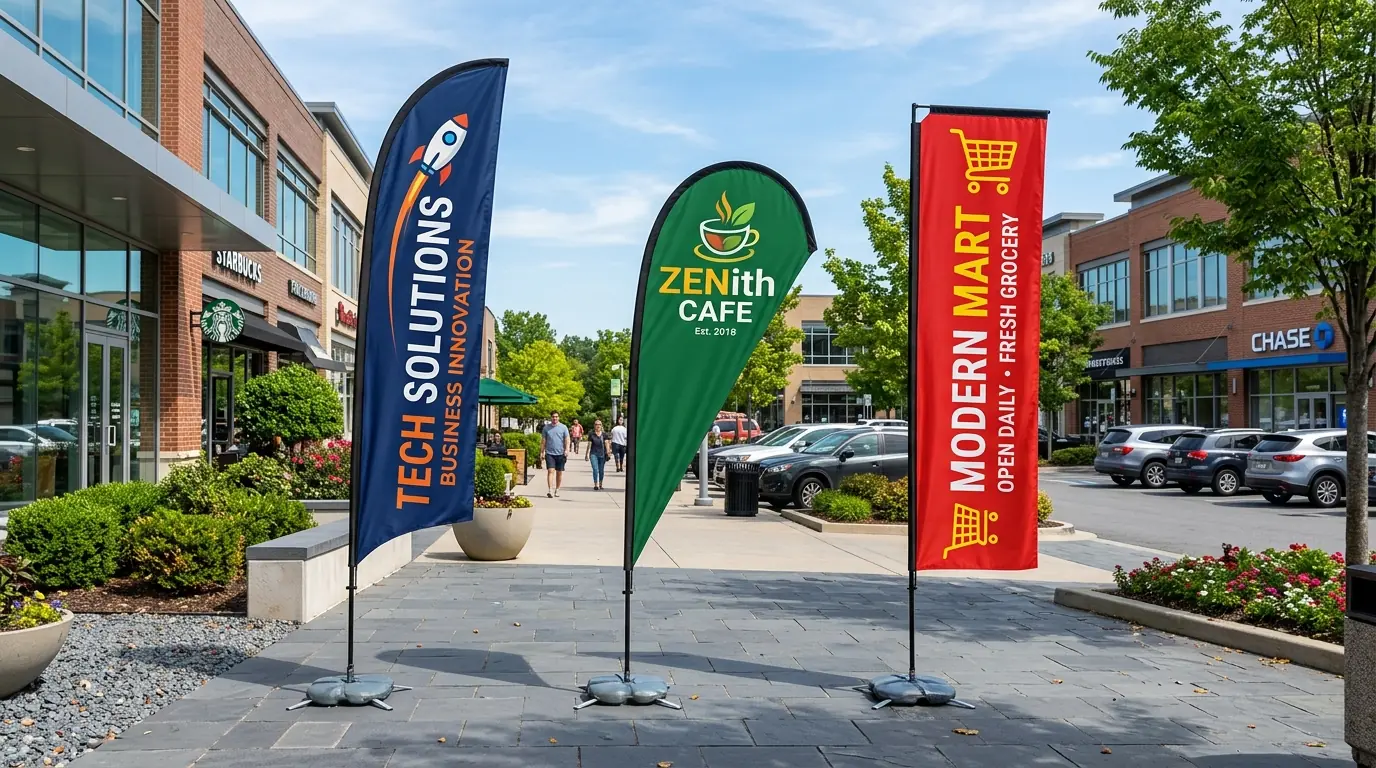
Feather flags have that distinctive tall, curved silhouette that tapers at the top. The key structural detail is that the bottom edge hangs free. It's only attached along the pole side, so the flag's lower portion flutters openly in wind. That movement is the whole point — it catches eyes from a distance. But "flutter" becomes "violent flapping" above a certain wind threshold, and your logo or phone number becomes a blur. As a custom feather flag manufacturer, we see this tradeoff play out constantly in customer reorders: the same businesses that love feather flags for calm-weather events switch to different shapes for their permanently installed locations.
Teardrop flags solve the flutter problem with a simple engineering choice: the fabric attaches to the pole at both top and bottom, creating a taut, enclosed shape. No free edges, no flapping. The flag stays readable in conditions that would turn a feather flag into a fabric tornado. The cost of this stability is a rounder, more compact shape that gives you less room for text and graphics.
Blade flags are the straightforward middle option — a straight-edged, linear silhouette closer to a traditional banner. They share the free bottom edge with feather flags (so they flutter), but the straight lines create a cleaner canvas for text-heavy designs. If you're lining up a row of flags along a car lot or event entrance, blades give you the most uniform, professional appearance. They also offer the largest usable print area of all three shapes, which matters more than most buyers initially realize.
Wind Performance: Why This Should Be Your First Filter
[aiwriter engine="anthropic/claude-sonnet-4.6" id="225" name="自动写内容段落要求"]Most buyers start by choosing the shape they think looks best, then deal with wind problems later. Reverse that. Start with where the flag will actually stand, then pick the shape that survives those conditions.
Teardrop flags are the clear winner for any location with consistent or unpredictable wind — coastal businesses, prairie locations, highway frontage, or anywhere with regular gusts. Because the fabric is tensioned between both attachment points, the design stays visible and legible even when wind is whipping around the flag. There's nothing to wrap, nothing to tangle. This is why custom teardrop flag manufacturer orders tend to come disproportionately from businesses in open-exposure locations.
Feather and blade flags behave beautifully in moderate wind — roughly the 5–20 mph range. The flutter looks intentional, eye-catching, almost like the flag is waving at passing traffic. Above around 25 mph, things deteriorate. The free bottom edge can fold over and wrap around the pole, hiding your design entirely. Fiberglass poles used in quality feather flag hardware have been tested to withstand gusts in the 70–80 mph range without snapping, so the pole survives — but the flag itself becomes unreadable long before you're anywhere near those speeds. Your hardware is fine; your marketing message isn't.
For indoor use — trade shows, expos, shopping mall lobbies — wind performance is basically irrelevant. HVAC airflow might cause slight movement on feather flags, but nothing disruptive. If your flags are exclusively indoor, pick based on design needs and aesthetics, not wind tolerance. But here's where buyers trip up: they buy flags for a trade show, love how they look, and then try to reuse them as permanent outdoor signage at their storefront. A flag that performed perfectly in a convention center becomes a liability on a windy street corner.
Design Space And Readability: The Mistake That Costs The Most Reorders
[aiwriter engine="anthropic/claude-sonnet-4.6" id="225" name="自动写内容段落要求"]This is where we see the most wasted money. A buyer chooses a teardrop flag because it looks sleek and professional in photos, then sends over a design with a phone number, website URL, tagline, and logo — and none of it fits properly in the tapered shape. The bottom third of a teardrop narrows so dramatically that anything placed there becomes too small to read from any useful distance.
Teardrop flags work best with minimal designs: a single logo, a brand mark, maybe a two-to-four word phrase. Think brand recognition, not information delivery. If your flag needs to communicate a phone number or a call to action, the teardrop shape is fighting you.
Feather flags offer substantially more vertical print area. The elongated shape suits multi-line text, vertical graphics, and portrait-oriented designs. Phone numbers stack well on feather flags. "NOW LEASING" with a phone number below it — that's a feather flag design that works. The curve at the top does eat into some space, but it's manageable.
Blade flags offer the largest usable design space of all three types — and this advantage is underappreciated. The straight edges and relatively uniform width mean you can treat the flag almost like a vertical banner. Detailed graphics, traditional advertising layouts with headline-body-CTA structure, even QR codes (if the flag is close enough to foot traffic) — blades handle all of it. For businesses that need their flags to function as actual advertising rather than just brand presence, blades are often the right call.
The practical advice: always mock up your design in the actual flag template before placing an order. Not in a rectangle, not in a generic shape — in the exact silhouette of the flag you're buying. Our OEM flag ordering process from design to delivery includes template mockups for this reason. If you skip this step and just send a logo file, you may not see the fit problem until the flags arrive.
Feather Flag vs Teardrop Flag: The Head-To-Head That Most Buyers Are Really Deciding
[aiwriter engine="anthropic/claude-sonnet-4.6" id="225" name="自动写内容段落要求"]Blade flags have their place, but the real decision for most wholesale buyers comes down to feather flag vs teardrop flag. These two dominate the promotional flag market, and the choice between them depends on one honest question: do you need attention or clarity?
Feather flags are attention machines. The flutter, the height, the movement — they pull eyes. For a car dealership that needs passing traffic to glance over, for an apartment complex competing with three other communities on the same road, for a grand opening where visibility matters more than reading a specific message, feather flags do the job. The tradeoff is that your design needs to be bold and simple enough to stay recognizable even when the fabric is in motion.
Teardrop flags are clarity machines. The design stays put. Letters stay sharp. Colors don't blur from motion. For a real estate office where passing drivers need to read a phone number, for a branded booth at a farmers market where your logo needs to be instantly recognizable, teardrops deliver the message intact. They don't grab attention from quite as far away — there's no motion to catch peripheral vision — but what they communicate, they communicate well.
If you're choosing for a client or for a location you can visit, stand across the street (or across the trade show floor) and ask: do I need people to look over here, or do I need them to read what this says? That single question usually settles the feather-vs-teardrop debate faster than any spec comparison. As a leading custom flag supplier, we consistently see the most satisfied repeat buyers being the ones who made that distinction upfront.
Setup, Portability, And Event Use
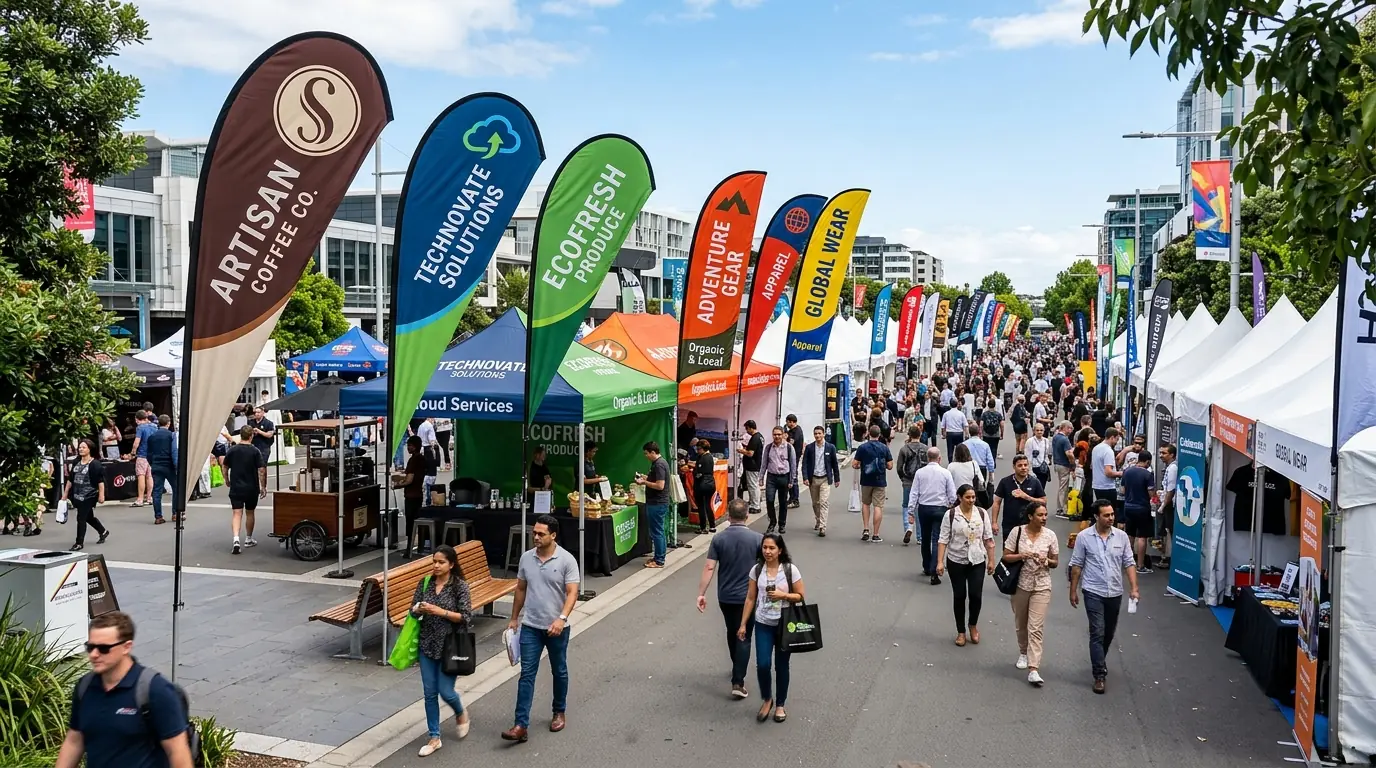
[aiwriter engine="anthropic/claude-sonnet-4.6" id="225" name="自动写内容段落要求"]Trade show buyers care about different things than storefront buyers. If you're packing flags into a car, setting them up in ten minutes, and tearing them down at 5 PM, portability and setup speed matter as much as the flag's appearance.
Teardrop and smaller blade flags pack down into bags around four feet long and go from bag to fully assembled in about three minutes. The pole systems are relatively simple — sleeve the fabric over the pole, tension the bottom attachment, drop it into a base. This makes them dominant at trade shows, outdoor markets, and pop-up events. If you're running a booth team that includes college-age part-timers who've never set up a flag before, simpler is better.
Feather flags and larger blade flags use telescoping poles that extend well beyond six feet when collapsed. They're bulkier to transport and slightly more involved to assemble — usually involving multiple pole sections that sleeve together. For a permanent or semi-permanent storefront installation where you set it up once and leave it for months, this doesn't matter. For an event team doing twenty setups per season, it adds up in time and vehicle space. Pair these with quality hardware from a wholesale flagpole supplier with bulk pricing and the pole system itself holds up through repeated assembly cycles — but the convenience gap between teardrop and feather setups is real.
One thing that doesn't get discussed enough: base weight requirements. Teardrop flags, because they're typically shorter and catch less wind, can use lighter bases — sometimes just a water bag or a small cross base. Tall feather flags in outdoor settings need heavier bases (ground spikes for soil, weighted cross bases for hard surfaces), and those bases add to your transport load. If you're doing a weekly farmers market from the back of an SUV, three teardrop flags with water bag bases are dramatically easier to manage than three feather flags with steel cross bases.
Cost And Durability: What Actually Affects Your Per-Year Spend
[aiwriter engine="anthropic/claude-sonnet-4.6" id="225" name="自动写内容段落要求"]Unit price at purchase is a poor way to evaluate flag cost. What matters is how long the flag lasts before it needs replacement — your cost per month of usable life.
Teardrop flags command a slight premium upfront, usually in the range of 10–20% more than equivalent-sized feather flags. The pole system is more complex because it needs to tension the fabric at both ends. But that taut design pays back in durability. Because the fabric isn't constantly fluttering and snapping, it experiences far less mechanical stress. The edges don't fray as quickly, the print doesn't wear along fold lines, and the fabric doesn't develop the micro-tears that eventually turn into visible holes. For a flag displayed outdoors year-round, a teardrop might last meaningfully longer than a feather flag in the same spot.
Feather flags wear faster specifically because of the constant motion that makes them effective. The free bottom edge takes the worst of it — that's where flutter stress concentrates. In moderate-to-high wind locations, it's common to see feather flag fabric showing visible wear within a few months of continuous outdoor display. The flag still functions, but the edges start looking ragged, and ragged flags send exactly the wrong brand message. Working with a custom promotional flag manufacturer that uses quality 110gsm or 115gsm knitted polyester helps extend life, but it doesn't eliminate the physics of flutter wear.
All three flag types typically use dye-sublimated polyester as the print medium — the ink becomes part of the fabric fiber rather than sitting on top, which makes it far more UV-resistant and wash-resistant than screen printing. Our dye sublimation and screen printing services for flags page covers the technical details, but the practical takeaway is that the print itself usually outlasts the fabric's structural integrity. Your flag will look faded from fraying before the colors actually fade from sun exposure.
Which Flag Type To Choose: A Decision Framework By Business Situation
[aiwriter engine="anthropic/claude-sonnet-4.6" id="225" name="自动写内容段落要求"]Instead of listing every possible scenario, here's how to think about the decision in three steps:
Step 1: Is wind a real factor at your display location? If yes — and "yes" means regular gusts above 15–20 mph, not occasional breezes — teardrop flags should be your default. Everything else is a compromise on readability. If wind is minimal or you're indoors, move to Step 2.
Step 2: Does your design need to communicate specific information, or just establish brand presence? Logo-only or short phrase? Any shape works. Phone number, URL, detailed text, or complex graphics? Blade flags give you the most room, feather flags are acceptable, teardrops will force you to simplify more than you probably want to.
Step 3: Are you installing once or transporting repeatedly? For events, pop-ups, trade shows — teardrop or smaller blade flags for portability. For permanent storefront or roadside use — feather or full-sized blade flags for height and visibility. The flag display system manufacturer hardware you choose matters here too; event hardware needs to be lightweight and tool-free, while permanent installations can use heavier-duty components.
The table below summarizes the practical differences, but use it as a reference after you've worked through the three steps above — not as a substitute for them.
| Factor | Feather Flag | Teardrop Flag | Blade Flag |
|---|---|---|---|
| Wind performance | Good in moderate wind; wraps in strong gusts | Best — stays taut and readable in all conditions | Similar to feather; flutters with free bottom edge |
| Design space | Good vertical area; curved top reduces some space | Smallest — tapered shape limits text and detail | Largest usable area; straight edges maximize print space |
| Eye-catching ability | Highest — flutter movement draws attention | Moderate — no motion, relies on color/design | Good — some flutter plus clean visual lines |
| Portability | Moderate — longer collapsed poles, heavier bases | Best — compact poles, lighter bases | Varies by size; smaller blades pack well |
| Setup speed | 3–5 minutes | 2–3 minutes | 3–5 minutes |
| Fabric durability | Shorter lifespan from flutter stress | Longest lifespan — taut design reduces wear | Moderate — similar flutter wear to feather |
| Unit cost | Lower | 10–20% premium | Similar to feather |
| Best for | Roadside attention, car lots, grand openings | Windy locations, trade shows, brand clarity | Text-heavy designs, uniform row displays, indoor showrooms |
Some specific situations where the choice becomes clearer:
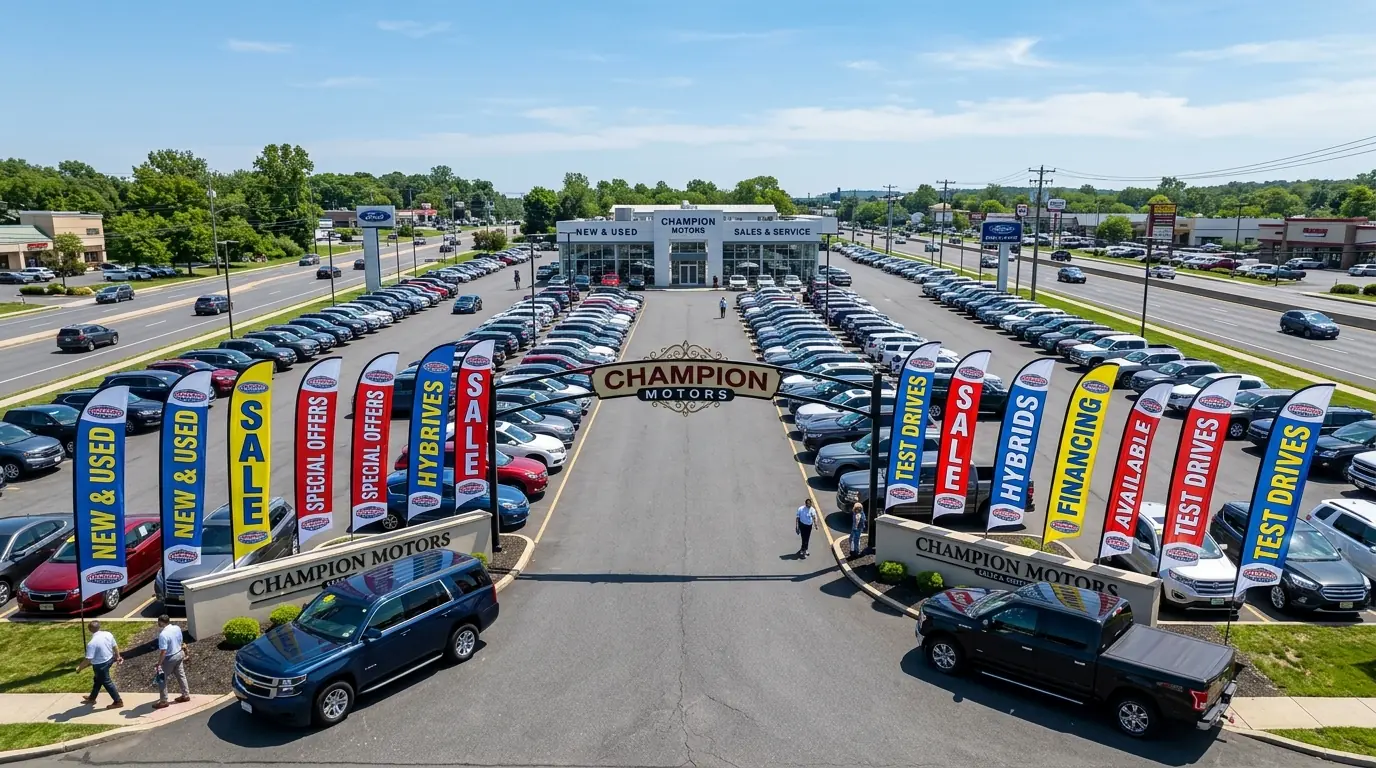
Car dealerships and apartment complexes almost always benefit from feather flags. These businesses need passing traffic to notice them from a distance, and the height and motion of feather flags serve that goal. The message is usually simple ("NOW OPEN," "SPECIAL EVENT," a brand name) so readability in wind is less critical than sheer visibility.
Trade shows and farmers markets lean toward teardrops. Portability, quick setup, and the fact that indoor/semi-outdoor venues often have unpredictable airflow from HVAC or open doors make teardrops the practical choice. Your booth neighbors will be using similar flags; the one that stays readable while others flutter is the one doing its job.
Indoor showrooms and corporate lobbies are blade flag territory. No wind to worry about, maximum design space, and the clean straight lines look more formal and professional than the organic curves of feather or teardrop shapes. Custom corporate flag manufacturer clients ordering for lobby installations choose blade shapes at a noticeably higher rate than for any other application.
Feather Flag vs Teardrop Flag: The Final Call
[aiwriter engine="anthropic/claude-sonnet-4.6" id="225" name="自动写内容段落要求"]The feather flag vs teardrop flag decision — with blade flags as the occasional third option — isn't about which flag type is objectively "better." It's about matching the flag's behavior to your specific situation. Wind, design complexity, and how often you'll be moving the flags are the three factors that matter. Everything else is aesthetic preference.
If you're placing a wholesale order and still unsure, here's what to do next: send your actual design file to a flag supplier and ask them to mock it up in all three shapes at the size you're considering. Seeing your specific logo, text, and colors in the actual flag silhouette eliminates most of the guesswork. Catalog photos of other people's flags won't tell you whether your design works in a teardrop taper or needs the full width of a blade.
For businesses ordering in volume for multiple locations or mixed use cases, a split order often makes the most sense — teardrops for your windiest locations and event inventory, feather flags for your roadside and high-visibility spots. You can request a free custom flag quote with mixed quantities to compare pricing across flag types before committing. The per-unit cost difference between shapes is small enough that optimizing for the right flag at the right location will always save you more money than standardizing on a single type and replacing the wrong ones twice as often.