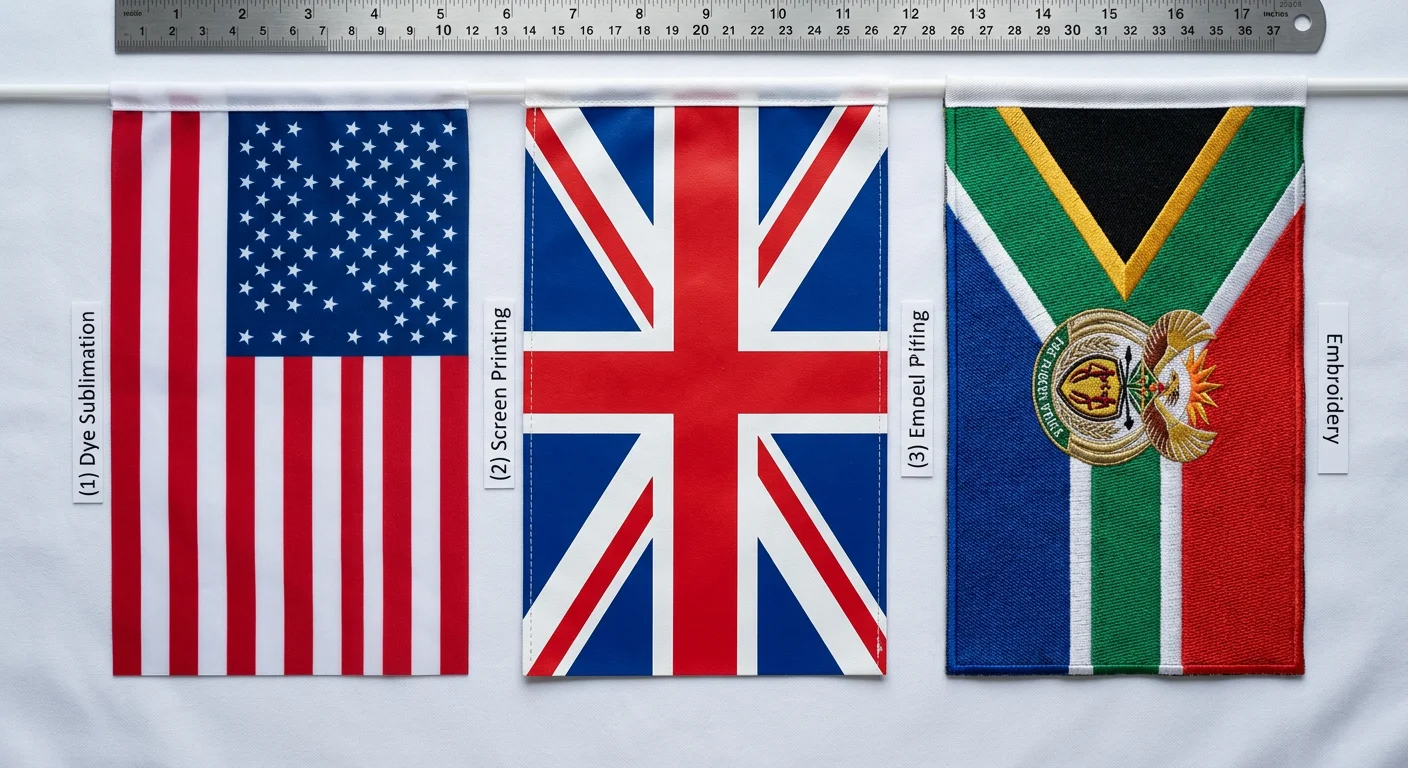
You're staring at three vendor quotes for custom flags, and none of the prices make sense. One is $22 per flag, another is $55, and the third came in at $68 — all for roughly the same size and fabric. The gap isn't markup or quality. It's the printing method each vendor is using, and that single variable swings your cost by 3-4x.
This guide breaks down dye sublimation and screen printing services for flags and digital direct-to-fabric printing by what actually matters: your order size, color complexity, and budget. No theory — just the price points, crossover thresholds, and hidden costs that determine which method saves you the most money.
Why the Printing Method You Pick Determines Your Final Cost More Than the Flag Itself
You called two vendors for the same 3x5 ft custom flag. One quoted $22 per unit. The other came back at $68. Same fabric, same size, same finishing. The difference? One quoted sublimation. The other quoted screen printing for a 10-piece order.
Most buyers waste hours comparing flag quotes that were never apples to apples. Vendor A prices sublimation with zero setup and a flat per-unit rate. Vendor B prices screen printing with $130 in setup fees and a lower per-unit cost that only kicks in at 50+ pieces. Without knowing which method each vendor uses, you're comparing two completely different cost structures.
Here's the actual spread: a standard 3x5 ft custom flag ranges from $8 per unit at high volume digital to $80 per unit for low-volume screen print or applique. The fabric and stitching barely move the needle. The printing method is doing the heavy lifting on your invoice.
And that's before add-ons creep in. Double-sided printing tacks on roughly 70% more. Weather-resistant upgrades and rush fees vary by method too. A screen print rush can double your total. A sublimation rush? Manageable, because there are no screens to burn on a deadline.
The bottom line: if you don't know which method a vendor is quoting, you can't evaluate the price. Every flag printing methods comparison starts here — match the method to your quantity and color needs first, then compare vendors using the same process.
Screen Printing: Cheapest Per Unit at Volume, Expensive for Small Runs
Screen printing is the go-to recommendation you'll hear from anyone who orders 500+ flags a year in one or two colors. And they're right — at that scale, screen print undercuts sublimation by 30-50% on simple designs. But below 50 units, the math flips hard against you.
The cost problem is setup. Every color in your design needs its own screen burned at $35-150 per screen. A 4-color flag logo means $200-600 in setup fees before a single flag gets printed. For a 10-piece order, that setup alone adds $20-60 per flag on top of the actual printing cost. Orders under 12 units typically get hit with a flat $50-75 small-order fee instead, which still pushes per-unit costs above $60.
Where screen printing wins is repetition. A 50-piece, single-color job breaks down to roughly $5 per print plus that one-time $35 screen fee. Spread across 50 flags, the setup adds less than a dollar per unit. At 500 pieces, your per-unit cost drops to $10-20 total depending on the base fabric.
The common mistake: buyers with 15-flag orders choose screen printing because the per-unit price on the quote looks low. They miss that the setup fee column effectively doubles their actual cost. For orders under 25 units with more than two colors, screen printing is almost never the right call.
There's also a design ceiling. Photo-realistic artwork, gradients, and complex color blends simply can't be reproduced with screens. Each additional color adds another screen, another setup fee, and more press calibration time. If your flag design has four or more colors, screen print vs sublimation flags isn't a close contest at any quantity under 200 units.
For the right buyer — 50+ identical flags, one to three solid colors, and no rush deadline — screen printing remains the lowest cost-per-unit method available. Everyone else should keep reading.
Dye Sublimation: The Budget-Friendly Choice for Small Orders and Complex Designs
If you need 1 to 50 flags and your design has more than three colors, sublimation is where the money math works best. No screens, no plates, no minimum order quantity. You send a digital file, and the printer runs it. Your setup cost is effectively zero.
The per-unit numbers tell the story. Consumables run about $5.80 per print — $0.50 for ink, $0.30 for transfer paper, and around $5 for the polyester substrate. Add operational costs and you're looking at roughly $7.70 per unit on the production side. A 10-unit order lands around $15.26 per unit all-in for materials. Compare that to screen printing's $60+ per unit at the same quantity.
The real advantage is color freedom. Eight thousand colors cost the same as one. Gradients, photographs, intricate logos — none of it changes your price. This is the only flag printing method where design complexity has zero impact on cost. For businesses with detailed brand artwork or photographic flags, this kills the screen print option immediately.
But sublimation has a ceiling too. Per-unit cost stays relatively flat as volume grows. At 500+ pieces with simple 1-3 color designs, sublimation runs 30-50% more expensive than screen printing. The crossover point sits around 50-100 units for basic designs — beyond that, screen printing's volume discount starts winning.
The sweet spot for sublimation buyers: under 50 flags, full-color designs, and situations where you might reorder different artwork later. Since there's no setup to repeat, your second order costs exactly the same as your first. For event companies, promotional flag suppliers for marketing events, and anyone who changes flag designs frequently, sublimation is the default choice.
One hard requirement: the fabric must be at least 65% polyester, with 100% polyester giving the best color transfer. Standard flag-grade polyester runs $3-5 per unit, so this isn't a cost barrier — just something to confirm with your vendor before ordering.
Digital Direct-to-Fabric: The Middle Ground with Better Durability
Digital direct-to-fabric sits between sublimation and screen printing on price, but it pulls ahead on one thing neither can match: outdoor longevity. Ink penetrates the entire fabric rather than sitting on the surface, which means no cracking, no peeling, and color that holds up after 12+ months of 24/7 sun and rain exposure.
The cost structure carries moderate setup — lower than screen printing's per-color screen fees, but higher than sublimation's near-zero startup. Per-unit pricing lands slightly above sublimation for small runs. The sweet spot is 25-200 units, where the setup cost spreads enough to be reasonable and the durability premium pays for itself.
What makes digital printing flags worth the slightly higher price is the double-sided capability. True 100% through-print — both sides visible from a single ply of fabric, no sewing two panels together. Sublimation needs a transfer paper step and can't achieve real double-sided printing on single-ply material. If your flags need to read correctly from both directions (think storefront flags or custom banner printing for trade shows and events), digital direct-to-fabric is the only single-step option.
Durability data backs this up. Polyester flags printed with digital direct-to-fabric inks match or exceed mesh banner lifespan in windy conditions. They resist UV fading, stretching, and abrasion at levels screen-printed flags can't sustain beyond a season of heavy outdoor use. Outdoor beach and display flags benefit from this same ink penetration advantage when flying full-time.
Who should pay the premium: businesses flying flags outdoors year-round, anyone needing double-sided print without the cost of sewing two flags together, and mid-volume orders (25-200 units) where the per-unit bump over sublimation is small but the lifespan difference is measured in years. If you're replacing screen-printed flags every six months because they fade, one digital print run saves money by the second cycle.
The Budget Decision Matrix: Your Order Size x Color Complexity
Stop comparing methods in the abstract. Your two variables are quantity and color count. Here's how actual pricing shakes out for 5x8 nylon flags using sublimation as the baseline:
The decision breaks down into four tiers:
1–10 Flags · Any Color Count
Sublimation or digital wins by default. Screen print minimums start at 6-12 units, and setup fees destroy margins on tiny runs. Don't even request a screen print quote at this volume.
25–50 Flags · 1–3 Solid Colors
Screen printing becomes economical once setup amortizes across enough units. But 4+ colors or photographic elements? Sublimation at $43.50/unit still beats screen printing with four separate screen setups ($200-600 in fees alone).
100–200 Flags · 1–3 Solid Colors
Screen printing is the clear winner on per-unit cost. For complex artwork at this volume, sublimation and digital hold their own — each additional screen color adds $35-150 in setup that erodes the bulk discount.
500+ Flags
Screen printing dominates for simple designs. For 4+ color work, sublimation and digital still win — color complexity adds zero price penalty while screen printing's per-color setup costs compound at scale.
The key insight from this flag printing cost by method breakdown: color count matters as much as quantity. A 200-unit order with six colors might cost less with sublimation than with screen printing, even though screen print is "cheaper at volume" as a general rule.
Hidden Costs That Change the Math
The per-unit price on your quote is never the full story. Here are the line items that quietly inflate your actual spend — and they hit different methods differently.
File Preparation Fees — $25–75
Sublimation and digital need print-ready files at 150-300 DPI in CMYK color. If your designer delivers RGB or low-resolution artwork, expect a $25-75 conversion fee. Screen printing requires vector files (AI or EPS format), and raster-to-vector conversion runs $25-50 per design. This cost is easy to avoid — just ask your designer for the right format upfront.
Color Proofing — $20–50 Per Design
Color proofing adds $20-50 per design regardless of method. Screen print offers the most reliable Pantone matching through wet proofs. Digital and sublimation send email proofs that may not match the final output, especially for brand-critical PMS colors. If exact color matching matters, budget for a physical proof sample.
Reorder Costs — Where Methods Really Diverge
Screen printing charges full setup fees again on every reorder unless the printer stores your screens — and screen storage runs $5-15 per screen per month. A 4-color design costs $20-60 monthly just to keep the screens on file. Sublimation and digital? Zero reorder setup. Same file, same per-unit price, no storage fees. For businesses ordering custom sports and event flag printing quarterly, this ongoing cost gap adds up fast.
Other line items that show up after the quote: premium 150-200gsm polyester adds $5-15 per flag, double-sided printing costs 60-80% more than single-sided, and shipping is almost never included in the per-unit price. Rush production hits screen printing hardest — its 5-10 day lead time versus 1-3 days for sublimation means expedited screen print orders carry steeper surcharges.
When to Break the Budget Rules: Quality Over Cost
Sometimes the cheapest method is the most expensive decision. Three scenarios where spending more per flag actually saves money long-term:
Outdoor Flags Flying 24/7 for 12+ Months
Digital direct-to-fabric costs roughly 20% more per unit than screen printing, but screen-printed flags fade and crack under constant sun and rain. You'll replace them two to three times before a digital-printed flag needs its first swap. The math: paying $45 per flag once beats paying $32 per flag three times.
Brand Flags Requiring Exact Pantone Color Matching
Sublimation approximates PMS values but can't guarantee precise Pantone numbers. For wholesale corporate flags with your logo where brand guidelines specify exact Pantone numbers, screen printing with physical wet proofs is the only method that reliably hits the target. The 5-10 day lead time and higher setup cost are the price of color precision.
Next-Day or 48-Hour Deadlines
Screen printing simply cannot deliver on this timeline without extreme rush fees that can double the total cost. Sublimation and digital handle 1-3 day turnarounds as standard production. If your event is Saturday and it's Wednesday, don't waste time getting screen print quotes.
Here's the decision shortcut:
- 24/7 outdoor, 12+ months — Digital direct-to-fabric. Pay the 20% premium, skip two replacement cycles.
- Exact PMS brand colors — Screen print with wet proofs. Accept the 5-10 day wait.
- Flags needed in 1-3 days — Sublimation or digital only. Screen print can't meet this window without painful rush fees.
- High wind or intense UV — Polyester with digital ink. Shape retention, no fade, no cracking.
The budget rules from the decision matrix above work for 80% of orders. These exceptions cover the other 20% — and ignoring them costs more than following them.
Making Your Final Call
Your printing method choice comes down to two numbers: how many flags you need and how many colors your design uses.
Under 50 units with complex artwork — sublimation wins on total cost every time. Zero setup, unlimited colors, fast turnaround. Over 50 units with 1-3 solid colors — screen printing's volume discount kicks in and delivers the lowest per-unit price. 25-200 units that need outdoor durability — digital direct-to-fabric costs slightly more but eliminates replacement cycles.
Before you request quotes, review our OEM flag ordering process from design to delivery and do three things. First, finalize your artwork and color count — this determines which methods even qualify. Second, confirm your order quantity, because the crossover points between methods shift every price tier. Third, ask every vendor which printing method they're quoting so you're comparing identical processes.
Get those three answers right, and the budget decision makes itself. When you're ready to move forward, request a free custom flag quote and reference your method and quantity to get accurate side-by-side pricing.