Your track meet needs directional signage for 3,000 spectators, the sponsor wants their logo visible from the parking lot, and the athletic director just asked for run-through banners by Friday. Every sports event has flag needs — and most organizers figure them out too late, at too high a cost. This guide breaks down which sports flag solutions work for which events, what hardware keeps them standing, where custom design goes wrong, and how to plan budgets and timelines so nothing arrives late or falls over mid-game.
Matching Flag Type to Event Format
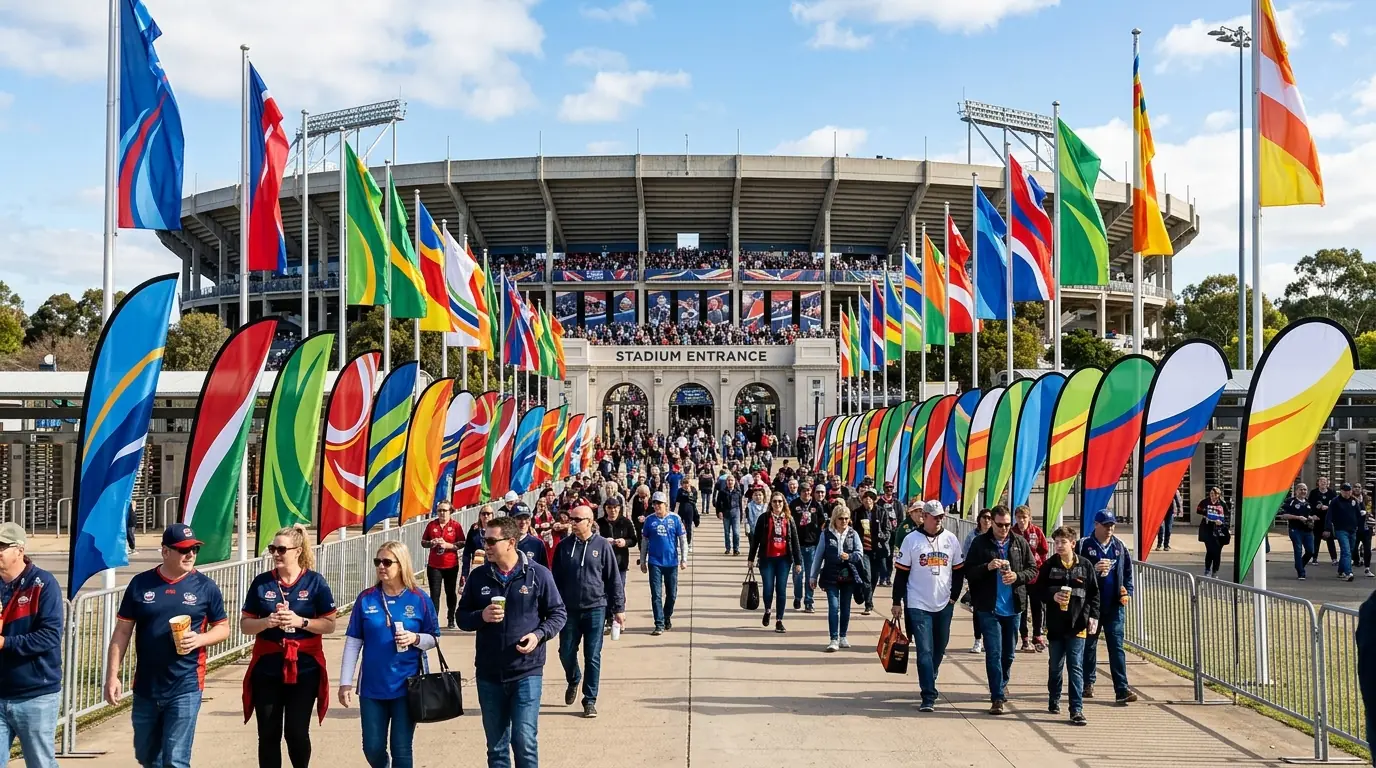
Three flag formats handle 90% of sports events, and picking the wrong one wastes money before the event even starts.
Feather and teardrop flags are your workhorses for outdoor events. The self-tensioning design stays taut in light wind without wrinkling, which matters more than most planners realize — a limp flag next to a registration tent signals amateur hour. Sizes run from 8 ft for sideline placement up to 17 ft for parking lot approaches, with full kits starting around $124.99. Teardrop flag variants outperform feather flags in sustained wind conditions and tend to last longer through multi-day tournaments.
Rectangular pole flags — the classic 3x5 to 10x15 ft format — remain the standard for team identity. Mount them at fields, courts, and tracks with UV-resistant nylon, canvas headings, and brass grommets. They do one job well: tell everyone whose territory this is. For a league running eight fields at a weekend tournament, rectangular flags at each field create visual consistency that feather flags alone cannot deliver.
Spirit runner flags are a different animal entirely. These are built for movement — lightweight polyester designed for physical carrying during player entrances, pep rallies, and half-time shows. Sizes from 3x5 ft to 6x10 ft, with custom options spanning 24 to 106 inches in width. The mistake organizers make is buying static-mount flags for a run-through entrance. A runner carrying a heavy nylon flag through a tunnel looks clumsy. Match the flag to the moment, not the other way around.
The real decision framework: if fans see it from a distance, go tall (feather/teardrop). If fans see it up close and stationary, go rectangular. If someone carries it, go spirit runner.
Outdoor Display Hardware — Getting Flags to Stay Up Through the Event
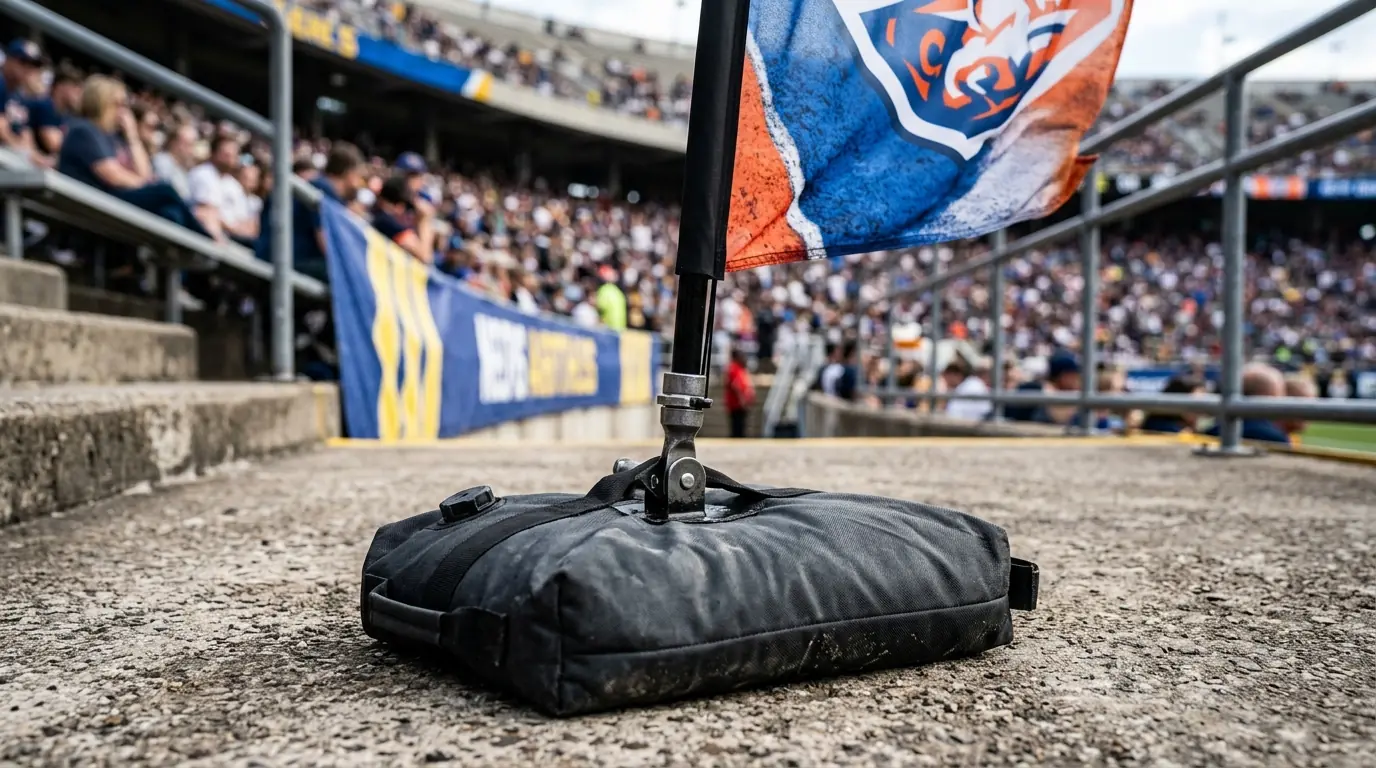
A $200 flag that falls over in the first hour is worse than no flag at all. Hardware choice depends on two things: what surface you are working with and how hard the wind blows.
Ground stake bases are standard for grass and soft turf — most feather flag kits include them. But here is where event planners get burned: compacted athletic field soil is not your backyard lawn. You need 12 to 18 inch stakes driven deep enough to hold through an afternoon of variable wind. Anything shorter and you are picking flags up between games.
Hard surfaces — concrete, asphalt, rubberized track — require sand or water-fill bag bases. These weigh 20 to 30 lbs when filled and work well for flags under 13 feet. Go taller than that in wind above 15 mph and you need two bags per flag. Skip this step and your 17-foot feather flag becomes a projectile. Pairing water bags with weight plates gives extra stability for those tall entrance flags that need to stay put all weekend.
For permanent installations at high school stadiums, college venues, or pro facilities, welded ground sleeves with fixed or telescopic flag poles are the standard. Companies like F.W. Haxel handle commercial flagpole installation with adjustable heights up to 18 ft and easy-swap fasteners for seasonal flag display changes. This is a one-time investment that pays off across years of events.
Placement matters as much as the base itself. Position weighted bases at entry points and main walkways where foot traffic is heaviest. Ground stakes work best along field perimeters where spectators naturally gather. Think about the path a first-time visitor takes from parking to seating, and flag that route.
Custom Sports Flag Design — What Event Organizers Get Wrong

Most reprinting costs in event budgets trace back to one mistake: submitting the wrong file format. Vector artwork — AI, EPS, or SVG files — is mandatory for clean flag printing. When organizers grab a PNG or JPEG from their website and send it to production, the result is blurry edges that look fine in the email preview and terrible on a 15-foot flag. Create your designs in vector format from the start, at 300 DPI minimum for any raster elements.
Color is the second trap. Screens display RGB; printers use CMYK — explore flag materials and printing methods. That vibrant team blue on your monitor will print differently without proper color conversion. Submit design files already in CMYK mode. If your school or league has official Pantone colors, include those numbers — it eliminates the guesswork entirely.
Viewing distance determines whether anyone can actually read your flag. The rule of thumb: every 10 feet of viewing distance requires at least 1 inch of letter height. A logo that looks sharp at 10 feet disappears at 50 feet, which is roughly where most spectators sit relative to sideline flags. Stick with simple sans-serif fonts like Helvetica or Arial. Decorative fonts that look great on a poster become unreadable on fabric blowing in the wind.
Single-sided flags work for directional signage and decorative placement against walls or fences. Double-sided is mandatory when flags are visible from both directions — entrance gates, center-field poles, boulevard mounting along a parade route.
One more thing organizers overlook: proofing. Skipping the digital proof stage is one of the costliest shortcuts. A $30 proof catches the color mismatch, the cropped logo, or the misspelled sponsor name before it becomes a $3,000 reprinting bill.
Sports Flag Solutions by Event Type
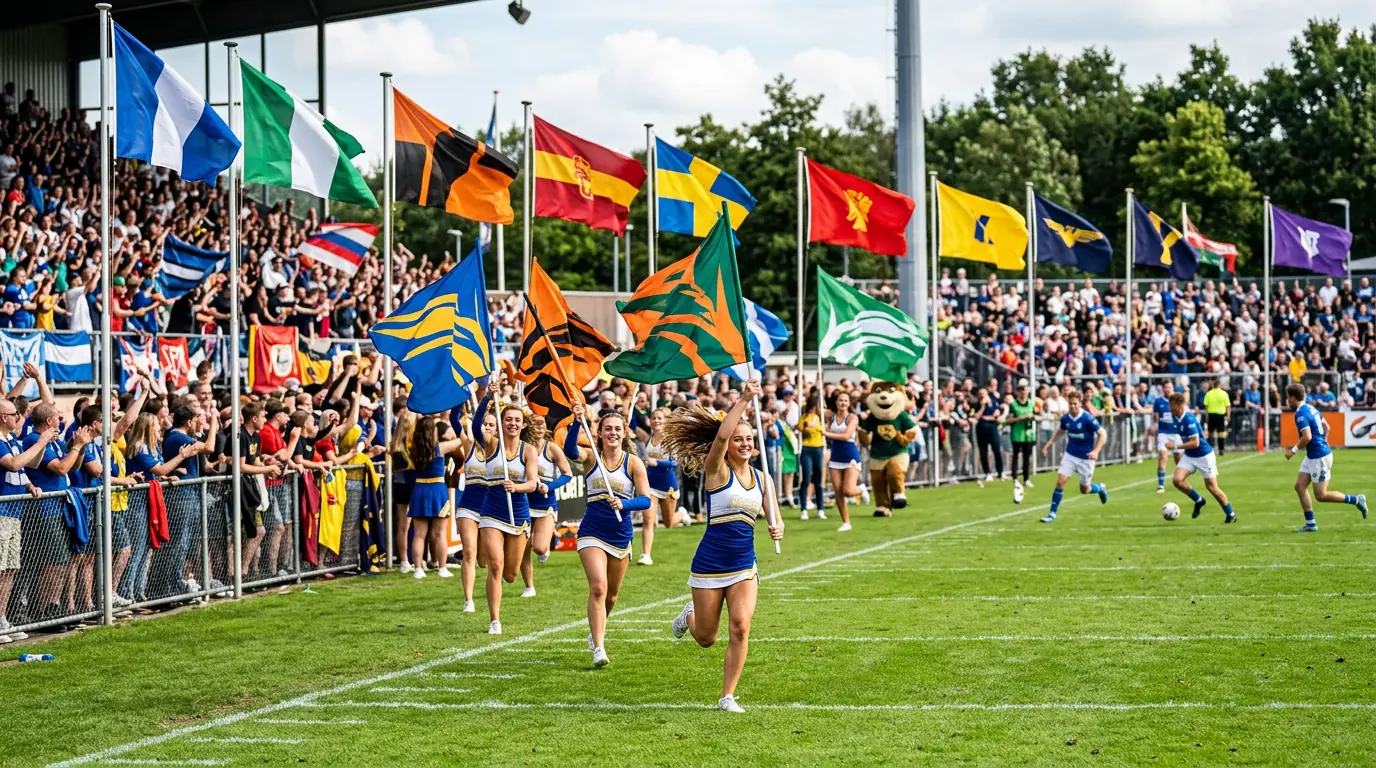
Not every event needs the same flag setup. Here is what actually works for the three most common scenarios.
Team pep rallies and pre-game entrances call for spirit runner flags in the 5x3 to 8x5 ft range with pole pockets. Use 4 oz dye-sublimated polyester — light enough for a cheerleader to carry at full sprint, durable enough to survive the season. Feature the mascot or team name in bold lettering. Production takes 5 to 7 days from approved artwork, so build that into your timeline. These flags are pure energy builders. They work because they move with the crowd, not because they sit on a pole.
Outdoor tournaments and multi-day events need a layered approach. Start with 15 to 17 ft feather flag kits at the venue entrance for parking lot visibility — include the rotating spike base, nylon carry bag, and fiberglass poles. Place 3x5 nylon team flags with canvas headings and brass grommets at each field or court. Then add directional banners for large format display for spectator flow: seating, restrooms, concessions, parking. A weekend tournament without directional signage loses goodwill fast when parents cannot find the right field.
Stadium and rafter displays demand different materials entirely. Outdoor hanging banners need 13 oz scrim vinyl with grommets spaced every 12 to 18 inches along the top edge for structural integrity. Indoor rafter banners work better in wrinkle-free fabric — no glare under arena lighting, and they hang flat instead of curling. Custom nylon, vinyl, mesh, or polyester banners built to last multiple seasons are the right call for permanent installations. High-visibility spots to prioritize: venue entrances, registration areas, concession stands, and the main seating sections.
Lead Time, Quantity, and Budget Planning
The fastest way to blow your flag budget is ordering late. Rush production — 1 to 3 days turnaround — runs a 50% premium fee. Standard production takes 5 to 10 business days from artwork approval. For events, plan a minimum of 3 weeks from brief to delivery through our production process to absorb revision rounds and shipping time.
Order size changes the timeline significantly. Under 100 flags, expect 8 to 11 days total from design through inspection. Scale up to 500 and you are looking at 10 to 15 days. Above 1,000 flags, production alone takes 12 to 15 days, bringing the total to 17 to 23 days before shipping. Express shipping adds 3 to 7 days; sea freight for bulk orders of 1,000+ takes 20 to 30 days but cuts per-unit shipping costs dramatically.
Volume pricing makes a meaningful difference for sports organizations. Most custom flag suppliers apply discounts at 10 units (10 to 15% off) and 25 units (20 to 25% off). Orders above 1,000 units reach wholesale discounts of 20% or more. Sports leagues ordering flags for an entire season across multiple teams should request bulk quotes rather than ordering team by team — the savings fund additional signage.
The rental versus purchase decision depends on event frequency. One-time events like a charity tournament or corporate field day benefit from rental programs offered by event supply companies. For recurring events — annual tournaments, league seasons, conference championships — purchasing pays for itself by year two. The flag still looks good in season three if you work with an experienced flag manufacturer and if you store it properly and chose UV-resistant materials upfront.
Sponsor Integration and Brand Visibility at Sports Events
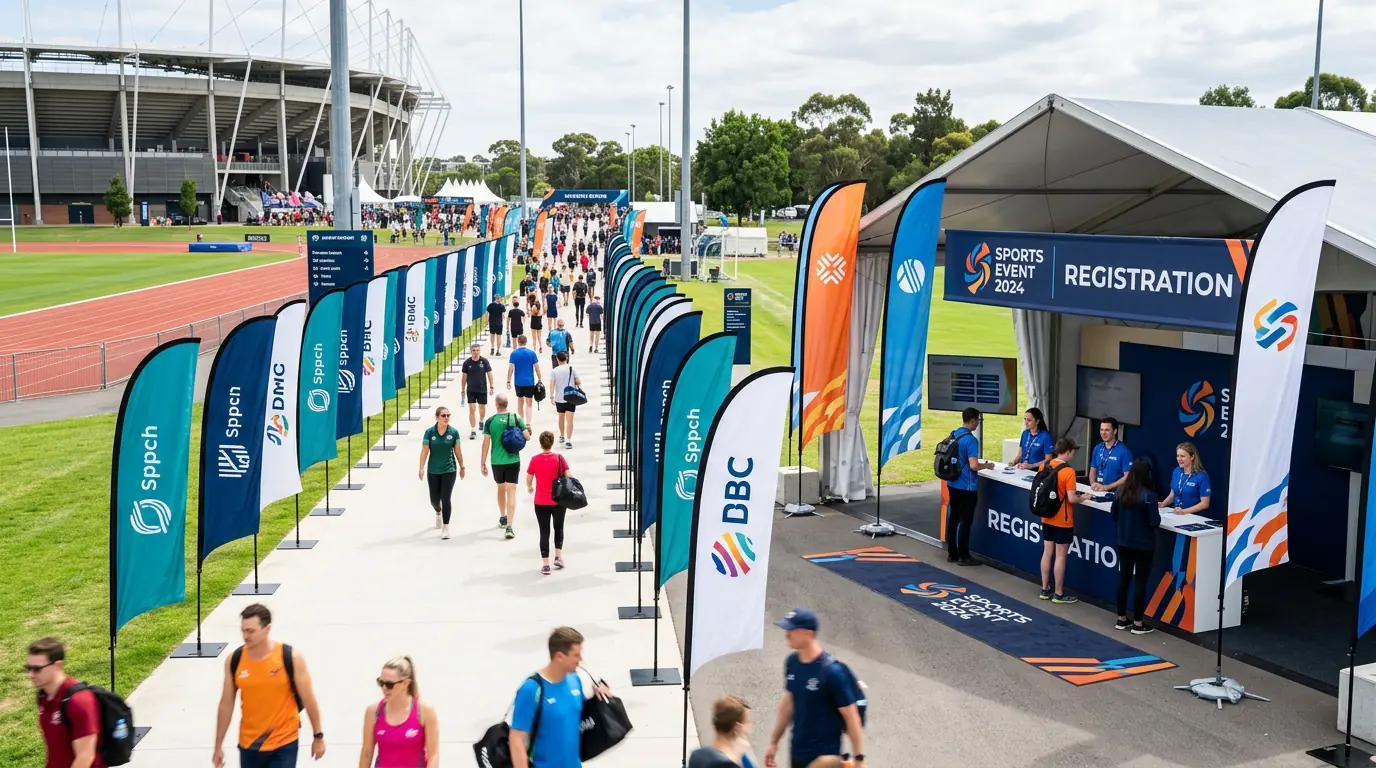
Sponsors fund a significant share of event budgets, and the flags you put up directly affect whether they renew next year. Feather flags at registration areas and sponsor booths deliver the highest visibility-to-cost ratio at most events — more noticeable than tent signs, far cheaper than digital screens.
Standardize sponsor flag sizes across the event. Use 3x5 ft for booth displays and 10x15 ft for main stage backdrops or field perimeter placement. When every sponsor flag is the same size and format, the event looks professional and no sponsor feels shortchanged relative to another at the same tier.
Tier your sponsorship visibility the way major events do. Title sponsors get their name worked into the event branding itself — think Emirates FA Cup or Tour de France presented by Skoda. Presenting sponsors appear directly after the event name. Official partners get category-specific recognition. Each tier should have a defined flag placement: title sponsors at every entrance, presenting sponsors at the main stage, official partners at their designated zones.
Multiple sponsor logos on a single flag work for smaller events where budget forces shared assets. The key is clear panel separation between brands — blending three logos into one chaotic design helps nobody. Use distinct color blocks or horizontal dividers so each sponsor is immediately recognizable.
Measuring the return matters more than most organizers acknowledge. Track social media mentions, photo shares that capture sponsor flags in the background, and direct sponsor feedback after the event. Jersey and kit placements consistently outperform static signage in photo capture rates, but strategically placed flags at high-traffic chokepoints — entrances, concession lines, award stages — deliver brand impressions that static venue signage misses.
Next Steps for Your Event
The gap between a well-flagged event and a forgettable one is smaller than most organizers think — it comes down to matching flag types to specific moments, choosing hardware that actually holds up, and ordering early enough to skip rush fees.
Start by listing every location at your venue where a flag adds value: entrances, field perimeters, sponsor areas, directional waypoints, and ceremony spots. Count the surfaces — grass versus pavement determines your base hardware. Lock in your artwork in vector format and request a digital proof before production begins.
For sports leagues and tournament organizers sourcing flags in volume, request a free custom flag quote with your full event specifications. The earlier you finalize quantities and designs, the more negotiating room you have — and the less you spend on rush production that should have been avoided.