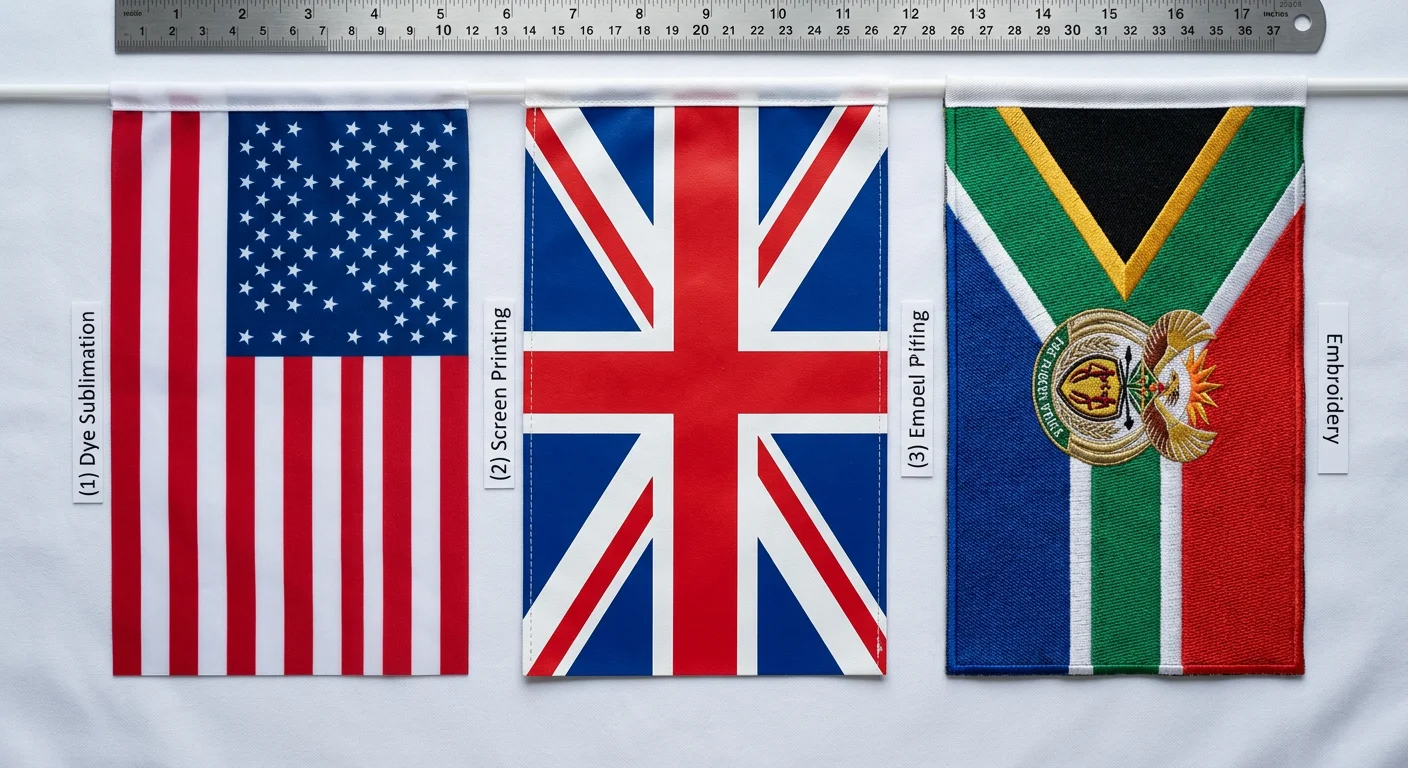
A few years back, my wife and I started selling custom flags through our online store. Sublimation was the backbone of our production — flag printing on polyester flags, banners, garden flags, the works. The process was dialed in and predictable. Then a customer asked if we could do t-shirts too.
My first instinct was sure, same ink, same printer, how different could it be? Turns out, different enough to waste a weekend and about forty dollars in ruined blanks before I figured out what was actually going on. The short answer is yes, you can sublimation print t-shirts — but if you press them the way you press flags, you'll get ghosting, dull colors, and fabric damage that makes the shirts unsellable.
This article breaks down what transfers from flag sublimation to t-shirt sublimation, what doesn't, and where the real cost of switching shows up. If you're already running a flag operation and thinking about adding apparel, this should save you the trial-and-error tax I paid.
Same Ink, Same Printer, Different Results
The confusing part about going from flags to t-shirts is that the core chemistry is identical. Sublimation ink turns into gas under heat, bonds with polyester fibers, and becomes part of the fabric. That doesn't change whether you're pressing a 3x5 garden flag or an adult medium tee.
What changes is how the fabric responds to heat, pressure, and time — and those differences are bigger than most people expect.
200–300
Flag Fabric GSM
Heavy weave — handles heat well
~150
T-Shirt Fabric GSM
Thinner — yellows at flag temps
Flags use thick polyester, usually 200 to 300 GSM. That heavy weave absorbs pressure well and tolerates longer dwell times without damage. A flag blank at 400°F for 60 seconds? No problem. Try that on a 150 GSM polyester t-shirt and you'll get yellowing along the collar and a texture that feels plasticky to the touch.
The other issue is structure. Flags are flat. T-shirts have seams, collars, zippers sometimes, and uneven surfaces that create pressure inconsistencies. A calender press that rolls through flag fabric continuously can't handle a garment that has a raised seam running down the side. You need a different press setup entirely, which I'll get into later.
So the ink works. The printer works. But the press settings, the blanks, and the handling are all different enough that treating a t-shirt like a flat piece of flag fabric will produce bad results almost every time.
Ready to Start Custom Flag Production?
Get professional sublimation printing on flags and banners — bulk pricing, fast turnaround, wholesale rates direct from our factory.
Get a Free Quote TodayFabric Differences That Change Everything
This is where most flag printers trip up first, because the fabric logic for flags is simple: buy 100% polyester, press it, done. T-shirts complicate that equation fast. Understanding flag fabric construction and how it differs from apparel is the first step toward getting consistent results across both product types.
Pure polyester t-shirts give you the best sublimation results — vivid colors, permanent bond, no fading. The catch is that 100% polyester tees have a specific feel. They're performance wear, athletic style. Not everyone wants that. Plenty of customers ask for a softer, more "cotton" hand feel, which pushes you toward poly-cotton blends.
And blends are where things get tricky. Sublimation ink only bonds to polyester fibers. Cotton fibers reject the dye completely — the ink just sits on the surface and washes out. A 50/50 poly-cotton shirt gives you a faded, vintage look at best. Below 65% polyester content, the print quality drops off a cliff. Colors look washed out on day one, and after three washes they're barely visible.
I learned this the hard way when a customer wanted a "soft" shirt with a full-color design. Pressed a 60/40 blend using my flag settings. The print looked decent for about ten minutes, then started fading just from handling. That's a $0 return on a shirt you can't sell and can't fix.
⚡ Polyester Content Quick Rule
If you're coming from flags, the rule is straightforward: start with 100% white polyester tees only. Get comfortable with the press settings, the handling, and the cooling process. Once that's consistent, you can experiment with 65/35 blends for a slightly softer product — but know that you're trading color vibrancy for hand feel, and the print won't match what you're used to seeing on your flags.
Temperature and Pressure: Stop Using Your Flag Settings
This section matters more than any other if you're a flag printer switching to shirts, because the instinct is to use what already works. Flag settings will damage t-shirts.
| Setting | 🚩 Flags | 👕 100% Poly Tee | 👕 Poly-Cotton Blend |
|---|---|---|---|
| Temperature | 380–400°F | ~385°F | 310–330°F |
| Pressure | Medium-Firm | Light (35–40 PSI) | Light |
| Dwell Time | 45–60 sec | 35–45 sec | <30 sec |
| Peel Method | Hot peel | Cold peel | Cold peel |
For flags, I run 380 to 400°F, medium-to-firm pressure, 45 to 60 seconds. That combination drives ink deep into a thick polyester weave and produces prints that survive outdoor flag weather conditions for months. It works because flag fabric is dense — 200-plus GSM — and it can take the heat without structural damage.
T-shirt fabric is thinner, lighter, and less forgiving. I found 385°F works best for 100% polyester tees, with lighter pressure — around 35 to 40 PSI — and a shorter dwell of 35 to 45 seconds. The lighter pressure is the big adjustment. Too much force on a garment-weight knit and you get a shiny, almost laminated surface that screams "cheap sublimation." Customers notice that texture immediately.
Poly-cotton blends need even more caution. Drop the temperature to 310 to 330°F and keep the press time under 30 seconds. Above 340°F on a blend with significant cotton content, you'll scorch the cotton fibers and get brown marks that ruin the shirt.
The other critical difference: pre-pressing. For flags I almost never bother — the fabric is thick enough that residual moisture doesn't cause problems. T-shirts are different. Three to five seconds at press temperature before you lay down the transfer paper removes enough moisture to prevent ghosting. Skip that step and you'll see blurry edges on fine detail work. It's a small habit change but it eliminates the single most common quality issue in t-shirt sublimation.
One more thing that caught me off guard — peel method. Flags I hot-peel after a brief cool-down. T-shirts need a cold peel. Pull the transfer while the shirt is still hot and you'll lift color and distort the fabric texture. Let it cool completely, then peel. Patience saves shirts.
⚠️ Pre-Press Every T-Shirt
3–5 seconds at press temp before laying down the transfer. Removes moisture that causes ghosting on fine detail work.
✅ Always Cold Peel on Shirts
Let the shirt cool completely before peeling. Hot-peeling lifts color and distorts the fabric texture — patience saves shirts.
The Equipment Gap Is Real but Not Expensive
If you're running flag production on a calender press — the wide-format roller type — that machine won't work for t-shirts. Full stop. The continuous roller feed crushes garment seams, can't handle the three-dimensional shape of a shirt, and applies uneven pressure across areas with different thicknesses. I've seen people try to flatten a shirt and run it through a calender. The result is a pressed pancake with ghosting along every seam.
What you need is a flatbed heat press — either a clamshell or swing-away style. For someone already in the flag business, the swing-away is worth the extra cost. It gives you more even pressure distribution and a full 360-degree arm swing that makes positioning the garment easier. An entry-level swing-away in the 16x20 inch size runs around $800. That's not a major capital expense when you're already generating revenue from advertising flags and other flag products.
A clamshell press is cheaper — some decent models start around $300 — but the pressure distribution is less even because of the hinge design. Fine for small runs or testing the market. Not ideal if you plan to do any volume.
🖨️ Clamshell Press
~$300
Entry Level
- Lower upfront cost
- Less even pressure
- Good for small runs & testing
- Not ideal for volume work
⭐ Swing-Away Press
~$800
Recommended
- Even pressure distribution
- 360° arm swing for easy loading
- 16×20" handles all shirt sizes
- Best for production volume
Beyond the press, you'll want garment-specific transfer paper and a Teflon sheet to protect the fabric. Budget maybe $50 for those consumables to start. Your existing sublimation printer and ink work fine — that's the one piece of your flag setup that transfers directly.
Need Custom Flags for Your Business or Event?
From advertising flags to sports event flags — we handle bulk orders with fast delivery and factory-direct pricing.
Explore Our Production ProcessWorkarounds for Cotton and Blended Shirts
Once you tell customers you do sublimation t-shirts, someone will ask for cotton. It happens every time. Pure sublimation doesn't work on cotton — the chemistry isn't there. But a few workarounds exist, and they range from practical to barely worth the effort.
What You Actually Need to Add T-Shirts to a Flag Operation
The good news for anyone already doing flag sublimation: the transition is smaller than it looks from the outside. Your printer stays. Your ink stays. Your design workflow stays. The changes are downstream — press equipment, blank selection, and settings. Before you invest in new equipment, it's worth knowing custom flag cost benchmarks so you can price your new apparel line competitively against your existing margins.
Here's what the actual shopping list looks like:
1
Swing-away flatbed heat press, 16×20" — budget around $800 for a solid mid-range unit
2
White 100% polyester t-shirt blanks — start with a case of 24 to test your settings before ordering in bulk
3
Garment-sized sublimation transfer paper
4
A Teflon sheet and heat-resistant tape
5
Blow-out paper (butcher paper works) to catch excess ink vapor and prevent ghosting on the back of shirts
Total upfront cost beyond what you already own:
~$900–$1,200
One thing I wish someone had told me earlier — don't try to match flag production speed on day one. T-shirts take longer per unit because of garment handling, alignment, pre-pressing, and the cold peel wait. My flag throughput is roughly double my t-shirt throughput on any given day. Plan your pricing accordingly. Shirts carry higher per-unit margins than flags for most sellers, which offsets the slower production pace.
Start with simple designs — full-front prints, no wrapping around seams. Get your temperature and pressure locked in on basic layouts before attempting all-over prints, which require specialized equipment and more advanced technique. Our custom process page walks through how we approach full-color production from file setup to delivery.
Making the Call: Is It Worth Adding T-Shirts?
If you're already sublimation printing flags and debating whether to branch into t-shirts, here's how I'd think about it.
The skills transfer. The chemistry knowledge, color management, file preparation — all of that carries over. What doesn't transfer is the physical process, and that's where a $800 to $1,000 investment in a proper heat press separates success from wasted blanks.
If most of your flag orders come from event companies, sports flags buyers, or businesses that also need branded apparel — adding t-shirts is almost a no-brainer. You're selling to the same customers with equipment you mostly already have.
If you're hoping to pivot entirely from flags to apparel, slow down. T-shirt sublimation has real constraints: white or light polyester only for true sublimation, limited options for cotton, and a different production rhythm. It's a complement to a flag business, not a replacement for one.
✅ Good Candidate to Add T-Shirts
- Flag orders from event companies or sports buyers
- Customers already asking for branded apparel
- Existing sublimation printer + ink setup
- Ready for $800–$1,000 press investment
⚠️ Slow Down — Reconsider First
- Hoping to replace flag revenue with apparel
- Need cotton or dark fabric options
- Polyester t-shirt process not yet stable
- Expecting flag-level production throughput
The first step is simple: order a case of white polyester blanks, get a swing-away press, and run ten test shirts at 385°F, 40 seconds, light-medium pressure. Adjust from there. You'll know within an afternoon whether the quality meets your standard and whether the production flow works in your space. If you're ready to expand your full product line — from banners to branded apparel — get a quote and we can walk you through your options.
Don't invest in cotton workarounds or blended fabric options until your polyester t-shirt process is rock solid. Get the basics profitable first. Everything else is an add-on.
📌 Key Takeaways
- Same ink, same printer — but press settings, fabric, and handling are completely different
- Use 100% white polyester blanks; blends below 65% polyester give poor and fading results
- T-shirts need lower temp (~385°F), lighter pressure (35–40 PSI), shorter dwell (35–45 sec)
- Always pre-press 3–5 sec and cold-peel — hot peeling lifts color
- Calender presses don't work; invest in a swing-away flatbed heat press (~$800)
- Total additional investment: ~$900–$1,200 beyond your existing flag setup
Expand Your Product Line with Custom Flags
Already doing apparel? Add high-margin custom flags and banners to your catalog. Factory-direct pricing, MOQ as low as 10 pcs, and 7-day turnaround available.
Talk to Our Flag Specialists