Australia's flag manufacturing industry is built around a small number of long-established domestic manufacturers, not the sprawling supplier ecosystem you find on Alibaba. If you are sourcing for government contracts, school supply, or institutional use where Australian-made matters, the supplier list is actually quite short. This guide walks through who is actually manufacturing in Australia, what they are best suited for, and how to evaluate suppliers before committing to a bulk order.
Australia's Flag Manufacturing Ecosystem
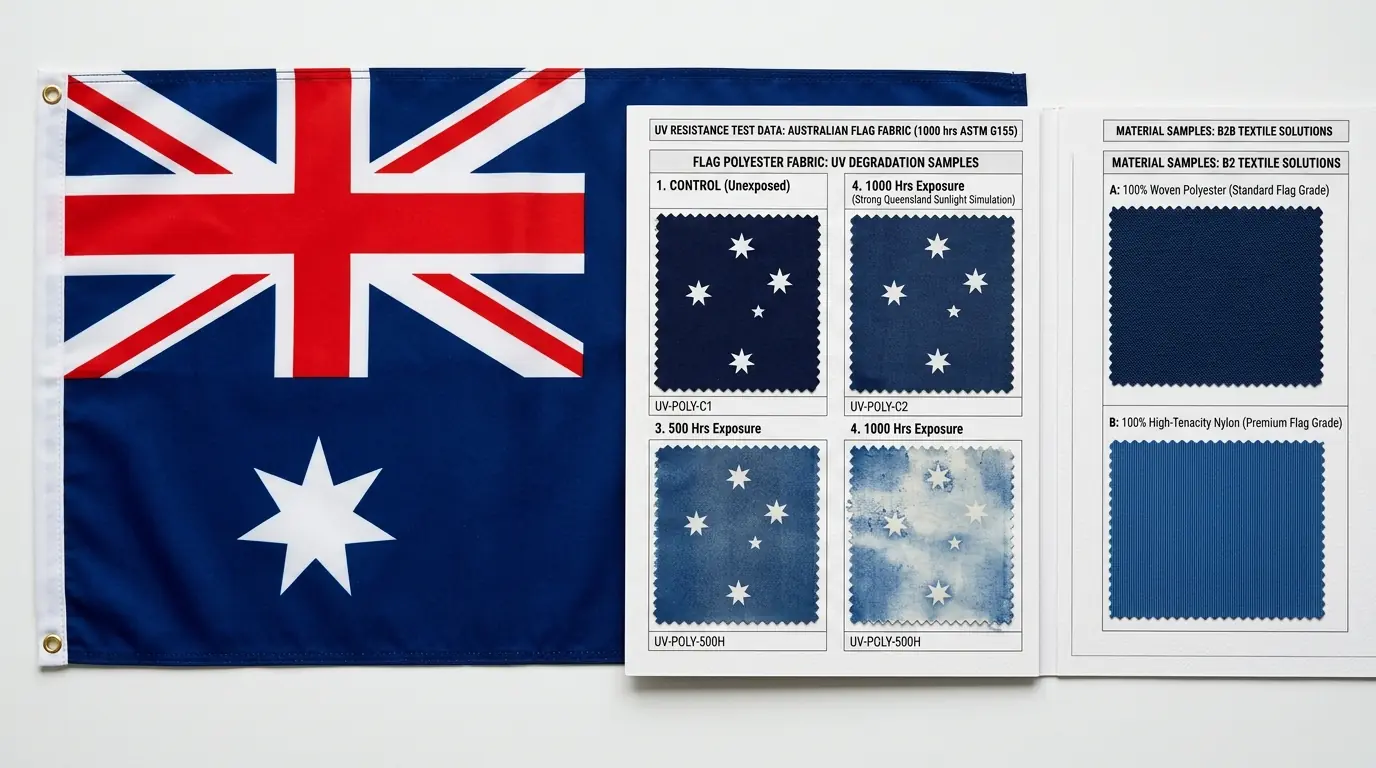
The domestic Australian flag industry has operated continuously since the 1970s, which makes it one of the more developed in the Asia-Pacific region. Fox Flags in Brisbane (est. 1976, 100 percent Australian-owned, in-house manufacturing) and Flagworld in Melbourne (60-plus years) are the two anchor manufacturers. Australian flags used at government buildings must comply with Australian standards, and domestic manufacturers understand those compliance requirements in a way that offshore suppliers typically do not.
The industry is small, which means inventory depth is more limited than what you would find from a UK or US wholesale supplier. Buyers needing obscure state flags or commemorative designs will find fewer options in ready stock.
Two things differentiate Australian domestic supply from imports: delivery speed within Australia (3 to 7 days versus 15 to 30 days from China) and the ability to provide manufacturing origin documentation for government procurement. For buyers who do not need either of those things, China-sourced supply at volume saves 40 to 60 percent per unit.
Top National Flag Manufacturers In Australia
Fox Flags (Brisbane, est. 1976) is the reference point for Australian-made flags. 100 percent Australian-owned, all flags manufactured in-house, and verifiable via ABN lookup. The 49-year operating history is the most credible single indicator of institutional reliability in this market. If you need documented Australian manufacturing origin, Fox Flags is the safest starting point.
Flagworld (Melbourne, 60-plus years) is the second major anchor, serving both custom and ready-made flag, banner, and signage buyers. Melbourne base gives strong eastern Australia coverage. Less publicly prominent than Fox Flags but with comparable institutional track record.
Australian Flag Makers (est. 2002) specifically positions itself for wholesale resellers, on-sellers, media companies, and advertising agencies. If you are an intermediary buying for resale to corporate clients, this specialization matters. Their wholesale pricing structure is oriented toward B2B buyers rather than end-users.
Flag Factory (est. 1974) specializes in institutional supply: government departments, schools, hospitals, sports clubs, military installations. They typically supply flags without hardware, which is appropriate when buyers are managing their own pole and display systems. If you are supplying a school district or council with multiple sites, Flag Factory's institutional focus is relevant.
Palmer Flags (est. 1981) offers competitive pricing with 40-plus years of market presence. Less specialized than Flag Factory or Fox Flags but a reliable option for general commercial supply.
Custom Flags Australia targets event organizers and businesses needing affordable custom flags with satisfaction guarantee. Oriented toward shorter-run custom work rather than standard national flag bulk supply.
Ausflags (Sydney) operates as an online specialist with express delivery options, useful for time-sensitive orders where you cannot wait for standard production lead times.
For institutional buyers evaluating multiple suppliers, Fox Flags and Flagworld are the two names with the strongest verifiable credentials. The other suppliers are viable for commercial and event supply, but for government documentation requirements, the established manufacturers are the safer choice.
Wholesale Specializations By Manufacturer
Australian Flag Makers' wholesale positioning for resellers is worth understanding. They are oriented toward B2B buyers who are purchasing for on-sale to corporate or event clients, not for direct end-use. If that describes your business model, their pricing structure and account terms are worth examining specifically.
Flag Factory's institutional supply model means they often handle multi-site contracts for councils, schools, and government departments. They supply flags without hardware by default, which simplifies procurement for buyers who manage their own installation contractors separately.
For event organizers who need quick stock from eastern Australia, Flagworld's Melbourne location provides the fastest delivery to Victoria, NSW, and Queensland. Fox Flags' Brisbane location serves Queensland and northern NSW with similar speed.
Bulk discount on standard Australian flag (180x90cm, commonly called 3x6ft) typically begins at 25-plus units across most domestic suppliers. Below 25 units, you are largely paying the same per-unit rate as retail customers. Above 100 units, the meaningful wholesale pricing usually applies. If your volume is consistently below 25 units per order, domestic manufacturers will serve you but you will not capture meaningful volume economics. For bulk national flag OEM manufacturer options at higher volumes, exploring China-sourced supply alongside domestic quotes is worth doing.
Climate Considerations For Flag Materials In Australia
Australia's UV intensity is among the highest globally, and this has practical implications for material selection that many buyers underestimate. UV-inhibitor treated polyester or UV-rated nylon should be the baseline specification for any outdoor installation in Australia. Standard polyester without UV inhibitors will fade and degrade noticeably faster in high-UV conditions.
Knitted polyester (typically 3.25 oz/yd squared, 100D to 200D) is tear-resistant and outdoor-tested. It performs well in UV and high-wind conditions. Nylon (200D Endura-Nylon grade) handles normal to high wind well and is long-lasting for commercial applications. Both materials are appropriate for Australian outdoor use when UV-treated.
Coastal locations including Sydney, Melbourne, and Brisbane require marine-grade materials with salt-air resistance. Standard polyester degrades faster in coastal salt-air environments. If you are supplying flags for waterfront or coastal installations, specify marine-grade and ask for lifespan data under salt-air conditions specifically.
Northern Territory and Queensland during wet season present the most demanding conditions: high wind, heavy rain, and extreme UV. Heavy-duty polyester, 150D or heavier, is the appropriate spec for permanent installations in these regions. For event or temporary use in northern Australia, lighter materials are acceptable given the shorter exposure period.
Understanding dye sublimation and screen printing services will help you specify the right production method for outdoor Australian conditions. Dye sublimation with UV-fast inks outperforms screen printing for long-term outdoor durability in high-UV environments.
Wholesale Pricing And Lead Times
Standard Australian flag (180x90cm) wholesale pricing runs roughly AUD $12 to $40 per unit depending on material and quantity. Budget digital print polyester at low volumes sits at the lower end. Premium sewn nylon at volume sits at the higher end.
Local manufacturers deliver within Australia in 3 to 7 business days for stock items. Custom orders run 10 to 15 business days. If you are working on a deadline, confirm whether stock items are actually in warehouse inventory or made to order before assuming the shorter lead time applies.
Importing from China saves 40 to 60 percent per unit but requires 15 to 30 days lead time and customs clearance management. At 25-plus units with 4-plus weeks of planning time, the cost math often favors China-sourced supply for buyers without origin requirements. At under 25 units or under 2 weeks of lead time, domestic supply is the practical choice regardless of cost.
How To Evaluate Australian Flag Suppliers
The most important question to ask any Australian flag supplier is whether manufacturing is actually done in Australia or whether they import finished goods. Some suppliers present themselves as Australian manufacturers but are actually importers with Australian addresses. For government procurement, this distinction is critical.
Verify suppliers via ABN lookup (Australian Business Number registry), which is publicly available and takes 30 seconds. A supplier without a verifiable ABN is a red flag. LinkedIn company presence and industry references provide additional verification. Fox Flags and Flagworld have the most publicly documented track records.
Request samples before committing to bulk. Ask for fabric weight spec in gsm, print method (dye sublimation versus screen print), and outdoor lifespan data under Australian UV conditions. A supplier who cannot provide these specs confidently is either not manufacturing in-house or is not testing their products systematically.
For government and institutional supply, request documentation of manufacturing origin before placing any order. For commercial and event buyers, a sample order is the most reliable quality check. Budget for 2 to 3 weeks for the full sample-evaluate-approve cycle before placing your bulk order.
When you are ready to compare domestic supply against imported options, request a free custom flag quote to establish a cost benchmark. And if you need display hardware alongside flag supply, flag display system manufacturer options can often be bundled with your flag order for consolidated procurement.
Conclusion
Australia's domestic flag manufacturing industry is small, capable, and specialized for institutional and government supply. Fox Flags and Flagworld are the reference manufacturers. For government procurement requiring documented Australian origin, start with one of these two and request ABN verification and manufacturing origin documentation.
For commercial and event buyers without government compliance requirements, the cost-quality-lead time calculation is worth doing explicitly. China-sourced supply at volume can reduce costs by 40 to 60 percent, and the quality of certified Chinese national flag manufacturers is genuinely competitive for standard designs. The 15 to 30 day lead time is the real constraint, not quality.
A practical approach for volume buyers: establish a domestic relationship with Fox Flags or Flagworld for government contracts and urgent replenishment, and source from a certified national flag OEM factory for planned bulk orders where you have planning lead time. The two supply channels serve different needs and they are not mutually exclusive.
Get in touch for bulk pricing on Australian national flags from a Chinese certified manufacturer if you are exploring cost reduction on volume orders without origin documentation requirements.